Tuesday, September 25, 2012
COCONUT LIME SUGAR COOKIES
When I make cookies, I usually want something involving chocolate or oatmeal, often both. Sugar cookies seem to boring to bother with—until I taste one and am reminded that they were one of my go-tos as a kid. This is probably because they tended to be frosting delivery devices, but still, a plain sugar cookie is nearly as delightfully nostalgic. What tempted me in this recipe, from Everybody Likes Sandwiches via Poppytalk, was the lime and the coconut, two of my favorite flavors—especially in the summer—but a combination I’ve never tried in cookie form. I was surprised to find that those elements are fairly subtle here, but I wasn’t too disappointed, because what resulted was essentially an excellent sugar cookie with the perfect crisp-chewy texture, but with intriguing notes of citrus and toasted coconut. They taste a lot like the sugar cookies my mom made when I was little, which she made with lemon extract (almond, of course, being reserved solely for holiday spritz). And they’re incredibly addictive.
Maybe it was because I baked these on a hot day, but mine turned out completely different than the ones in the photos accompanying the original recipe; those are thick and rounded, whereas mine are wide and flat, bakery-style. Whatever I did, I want to do it again, because the texture was my favorite thing about these cookies. I kept daydreaming about how perfect they would be as the base for an ice cream sandwich. Someone should get on that, stat.
These cookies are already on the sweet side, so do make sure you use unsweetened coconut. I found mine in the bulk section at Whole Foods.
2¾ cups all-purpose flour
½ cup unsweetened (dried) shredded coconut
1 teaspoon baking soda
½ teaspoon baking powder
½ teaspoon salt
1 cup butter, softened
1½ cups white sugar, plus about ¼–½ cup extra for coating the cookies
1 egg
½ teaspoon vanilla extract
Zest from 1 or 2 limes
3 tablespoons fresh lime juice
1. Toast coconut in a small sauté pan over medium heat until fragrant and lightly browned.
2. Preheat oven to 350 degrees and line baking sheets with parchment or Silpat.
3. In a medium mixing bowl, whisk together flour, toasted coconut, baking soda, baking powder, and salt. Set aside.
4. In the bowl of a stand mixer fitted with the paddle attachment, or in a large mixing bowl using a hand-held mixer, cream the butter and 1½ cups sugar together until fluffy. Add the egg and mix well, then add the vanilla, lime zest, and lime juice. Slowly mix in the dry ingredients until combined.
5. Place some sugar (start with about ¼ cup and add more as needed) in a shallow bowl. Form dough into heaping-teaspoon-sized balls and then roll in sugar. Flatten slightly and place on lined cookie sheets two inches apart. Bake for 10 minutes or until bottoms are lightly browned. Cool for a few minutes before moving to a wire rack to cool completely.
Makes: 2–3 dozen
Time: 40 minutes
Leftover potential: High, if stored in the freezer; if stored at room temperature, the chewy texture will disappear after a couple of days.
Monday, September 17, 2012
ROASTED CHERRY TOMATOES
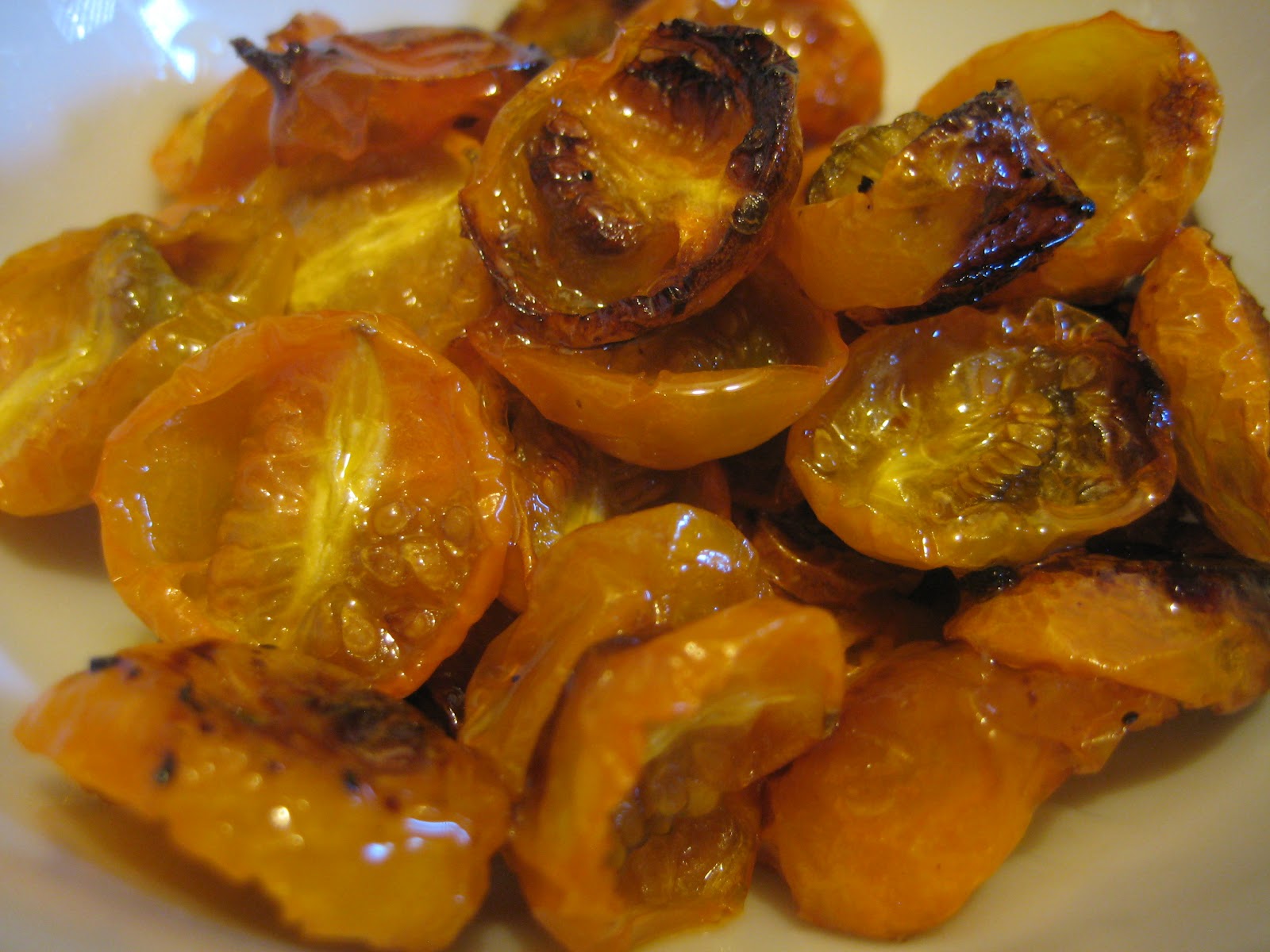
Here’s another secret I’ve been keeping from you: the best thing ever to do with leftover cherry tomatoes (or grape tomatoes, or whatever shape the little guys happen to be). I don’t know about you, but often I used to be plagued by partially used baskets of small tomatoes; sure, you can just eat the really good height-of-summer ones out of hand, but what about the slightly softened, wizened ones that remain at the end of the week, or the less-than-desirable wintertime grocery-store ones that taste OK when cooked but are bland when raw? If I couldn’t sneak them into a meal somewhere, too often they’d end up in the trash. One Friday, faced with yet another wilting cherry tomato surplus, I started Food Blog Searching and found this recipe at Leite’s Culinaria, from Heidi Swanson’s Super Natural Every Day. I didn’t have to buy any special ingredients, and it was so easy to throw together that I figured the stakes would be low if I failed, so I decided to give it a shot, letting the tomatoes brown in the often while I watched a movie, filling the apartment with a wonderful aroma. Putting maple syrup on tomatoes felt strange, but that dash of extra sweetness was the key to transforming my wrinkly old bottom-of-bowl specimens into amazingly addictive bits of caramelized tomato candy. (For best results, use Grade B syrup, which lends a tantalizing smokiness.)
I’ve always hated sun-dried tomatoes—the raisins of the tomato world!—but these were worlds away from any of the bitter, leathery monstrosities I’ve ever had. The flavor concentrates, but some juiciness remains, along with an irresistible tender-chewy texture (yes, these will stick in your teeth and you will love it) and the perfect sweet-tart-salty balance that all the finest snacks possess. I ate every single one straight off the baking sheet that day, and I’ve made these probably a dozen times since then, often just a half-recipe or less, depending on how many orphaned cherry tomatoes are on hand. The recipe is so simple, barely a recipe at all once you’ve made it a couple of times, that I tend to do this as an afterthought and immediately devour the evidence without photographing it. But finally, this time around, the lighting was pretty good and I already had my camera in the kitchen to document something else I was working on when these tomatoes came out of the oven, and now I can finally share these with you. Make them before tomato season is over! Or, if you must, make them in January with out-of-season ones from South America; it’s the best treatment for those poor things and will convert them into something far better. If you don’t want to eat them straight out of the oven, I’m sure they’re wonderful on pizzas, pasta, salads, and more. Just don’t forget to snack on the hardened puddles of syrupy juice that adhere to the edges of the parchment—they may look blackened and burnt, but peel them up and pop them in your mouth and they’re like little bites of toffee. Tomato toffee!
1 pint cherry tomatoes, any color, stemmed
¼ cup extra-virgin olive oil
1 tablespoon Grade B maple syrup
½ teaspoon coarse salt
1. Preheat the oven to 350 degrees.
2. Slice the tomatoes in half and place them on a parchment-lined rimmed baking sheet.
3. In a small bowl, whisk together the olive oil, maple syrup, and salt. Pour the mixture over the tomatoes and gently toss until well coated. Arrange the tomatoes in a single layer, cut side up, and roast, without stirring, until the tomatoes shrink a bit and caramelize around the edges, 45 to 60 minutes.
Time: 1 hour
Leftover potential: Good; I like to eat them right away, but they’ll keep for about a week in the refrigerator. Just let them cool, scrape them into a glass or plastic container along with any liquid that was left on the baking sheet, and seal tightly.
Friday, September 14, 2012
ORANGE QUINOA SALAD WITH CHICKEN, CUCUMBER, AND CRANBERRIES
This is my new favorite quinoa salad and it isn’t even really a quinoa salad. The original Cooking Light recipe called for couscous, which I’m no particular fan of; it’s really just tiny pasta, and as you know, I already have enough pasta recipes to last a lifetime, so if I’m going to eat a grain-like salad I want it to be made with actual whole grains (or, in quinoa’s case, seeds). I became obsessed with adapting it for quinoa, even though I wasn’t sure whether boiling quinoa in orange juice and spices would work (with couscous, of course, you just soak it) or just result in a sticky, bitter mess. I’m pleased to report that it works just fine, infusing the quinoa with tons of flavor along the way.
Also new to me was poaching chicken; I usually have some cooked chicken in the freezer left over from making chicken broth, but this long, hot summer hasn’t exactly been conducive to keeping boiling pots on the stove for hours, so I was without. I’d tried poaching chicken a few times early in my cooking career and it always turned out dry and bland, but Just Bento set me straight. It turns out that the secret to perfectly moist poached chicken is the same as the secret to perfect hard-boiled eggs: bring to a boil, then remove from heat, cover, and let sit in the hot water until cooked. (The other secret is plenty of salt, so that essentially you’re brining the chicken.) Magical!
This salad has everything you could want (from a salad, at least). It has textural contrasts: the chewy quinoa, the crisp cucumber and onion, the crunchy almonds, and the tender chicken. It has flavor contrasts: the sweet-tart cranberries and citrus, the warm spices, the fresh green cucumber and cilantro, the meaty chicken, the sharp onion, the salty mustard, the nutty quinoa and, well, nuts. It’s packed with protein from the chicken, quinoa, and almonds, making it a satisfying dinner or workday lunch. It has fruit, nuts, vegetables, meat, and starch, and although it doesn’t need any more help in the deliciousness department, if you want to round out the food groups you can add a little crumbled feta as well (I wouldn’t bother buying feta for this purpose, but since I had a little leftover chunk in the fridge that I needed to get rid of, I tried it and it certainly wasn’t a bad addition). I especially love how well it bridges the gap between summer and fall. As I’ve mentioned, September in Southern California tends to make me cranky because the rest of the country is moving on to autumnal foods while we’re still sweating through our hottest weather of the year. With the orange, cranberry, cinnamon, and mustard, this salad wouldn’t be out of place at Thanksgiving, yet it’s quick, cold, and refreshing enough for the most sweltering days. I love it so much that I’ve made it twice in three weeks. Even if you’re a quinoa skeptic, this is one you have to try.
1 cup freshly squeezed orange juice, divided (from 2–3 oranges)
¾ cup water
1 teaspoon salt, divided
1 teaspoon ground coriander
¼ teaspoon ground cinnamon
¼ teaspoon black pepper, divided
1 cup uncooked quinoa, rinsed and drained
¼ cup sweetened dried cranberries
¼ cup sliced almonds
1½ cups chopped, cooked chicken breast*
1 cup chopped cucumber
⅓ cup chopped red onion
¼–½ cup chopped fresh cilantro
1–2 tablespoons freshly squeezed lime juice
2 teaspoons Dijon mustard
1½ tablespoons extra-virgin olive oil
*I used poached chicken, made as follows: Take about 1 pound boneless, skinless chicken breasts, cut them in half lengthwise so they’re less thick in the middle, and place in a heavy, shallow pan (one that has a tight-fitting lid, which you’ll need later). Add water just to barely cover and 2 teaspoons salt, and bring to a boil over high heat. Turn chicken over, remove pan from heat, cover, and let rest for 10 to 15 minutes or until chicken is no longer pink in the middle. Remove from pan, let cool slightly, and dice. This will make a bit more than you need for this recipe, but it can be added to many other dishes (salads, tacos, pizza, etc.) and freezes well.
1. Combine quinoa, ¾ cup orange juice, water, ½ teaspoon salt, coriander, cinnamon, and ⅛ teaspoon pepper in a medium saucepan; bring to a boil over high heat. Cover, reduce heat to medium-low, and cook until liquid is absorbed and quinoa is tender, about 15–20 minutes. Remove from heat; stir in cranberries. Cover and let stand 5 minutes; fluff with a fork. Transfer quinoa mixture to a large bowl and let cool to room temperature.
2. Heat a small skillet over medium heat. Add almonds to pan; cook 3 minutes or until toasted, stirring frequently. Set aside and let cool.
3. Whisk together remaining ¼ cup orange juice, ½ teaspoon salt, ⅛ teaspoon pepper, lime juice, and mustard. Gradually add oil to juice mixture, whisking constantly until emulsified.
4. Add almonds, chicken, cucumber, red onion, and cilantro to the bowl of cooled quinoa. Drizzle dressing over the tip and toss well to coat.
Serves: 4
Time: 40 minutes (1 hour if you’re also poaching the chicken)
Leftover potential: Great.
Thursday, September 13, 2012
EASY CHICKEN SATAY WITH PEANUT SAUCE
I wanted a little protein with my spring rolls, and since A and I will often order nothing but an assortment of appetizers when we get dinner from our local Thai restaurant, chicken satay (or saté, but I don’t feel like inserting that accent mark every time) seemed the perfect accompaniment, especially since peanut sauce could do double duty as a condiment for both. I’d spent so much time rounding up ingredients for the spring rolls that I picked this satay recipe from Cooking Light mainly because it was quick and easy and didn’t require me to buy anything new. It seemed so simple that as I was assembling it I began to doubt that it would taste like much at all, but happily, I was wrong. In the future I’d marinate the chicken for longer if I have the time, but even after 10 minutes’ soak it was surprisingly flavorful.
I doubled the sauce so I could use some of it as a spring roll dipping sauce. A thought it was fine on both foods, but for some reason I disliked it on the spring rolls while really enjoying it on the chicken. When I’m feeling more ambitious I might try more complex recipes for both—I’d like to imitate our Thai place’s satay, which involves coconut milk and curry powder—but I’d definitely make this one again in the meantime. It’s hard to go wrong with sweet and zesty grilled chicken for very little effort, after all.
I did this on the George Foreman, skipping the skewers entirely; you could also use a broiler if you don’t have a grill.
Satay:
1 pound skinless, boneless chicken breasts, cut into 8 strips
1 tablespoon brown sugar
2½ tablespoons low-sodium soy sauce
2 teaspoons minced fresh ginger
1 teaspoon lime zest
¼ teaspoon red pepper flakes
2 garlic cloves, minced
Peanut sauce:
1 tablespoon brown sugar
1½ tablespoons low-sodium soy sauce
1 tablespoon freshly squeezed lime juice
2 tablespoons natural-style creamy peanut butter
¼ teaspoon red pepper flakes
1 garlic clove, minced
1. Prepare grill.
2. Combine chicken and remaining satay ingredients (through 2 garlic cloves) in a medium bowl. Let stand 10 minutes.
3. While the chicken marinates, combine peanut sauce ingredients in a medium bowl, stirring until sugar dissolves.
4. Thread each chicken strip onto a wooden skewer. Place chicken on grill rack coated with cooking spray; grill 5 minutes on each side or until chicken is done. Serve satay with sauce.
Serves: 4
Time: 30 minutes
Leftover potential: Good.
Wednesday, September 12, 2012
SPRING ROLLS
This one’s really an oldie; I remember making spring rolls for summertime dinners when I lived on my own in St. Paul in my mid-twenties. I have no idea what the original source is; back then, when the Internet wasn’t the first place we looked for information, I used to check heaps of cookbooks out of the library and photocopy appealing-looking recipes. I haven’t spring rolls this since I moved to California 8½ years ago, partly because we have a beloved Thai restaurant a block away that makes great, inexpensive ones, and partly because I’ve been too lazy to seek out the ingredients. In St. Paul, rice wrappers were readily available in ordinary chain grocery stores, but for whatever reason, none of my usual shopping stops in Pasadena carry them. Luckily, I live on the edge of the San Gabriel Valley, which has a huge Asian American population (fun fact: eight of the ten cities in the United States with the largest proportion of Chinese Americans are located in the San Gabriel Valley!), yet it still took me nearly a decade to muster the energy for a field trip. (My commute to work is long, so on the weekends, I can rarely bring myself to pilot a car for more than a mile or two.) But this summer, with our local Thai restaurant under new management and threatening to change, and a disgustingly sticky heatwave making it impossible to contemplate turning on the stove or ingesting warm food, the time was finally right to make my own spring rolls again. A quick Googling guided me to a well-reviewed Asian grocery about five miles away, in San Gabriel. Somehow I managed to get lost going there, but after I’d driven in circles for 15 minutes I suddenly realized that I was surrounded by dozens of other Asian grocery stores that could provide exactly what I needed. Sure enough, the random place I stopped (sadly, I’ve already forgotten its name) had an entire wall of spring roll wrappers in a dizzying array of sizes and varieties. After some deliberation, I went with the Double Parrot brand (“Good for restaurant”) because they were made entirely of rice (other some kinds also contained tapioca flour, which I’m sure isn’t a bad thing or probably even a noticeable difference, but I figured I’d been instructed to get “rice wrappers,” so…) and had a pretty label, in a package large enough to see me through multiple batches of spring rolls.
And that was the hardest part of the spring-roll-making process. Second-hardest was tracking down bean sprouts, which—are they out of fashion or something? Is it the increased food-borne illness fear? Because they’re another ingredient I used to be able to pick up at an ordinary grocery store in St. Paul, but I had to scour four different places here (I finally found them at Fresh and Easy, in case anyone is wondering). The bean thread (saifun) noodles I just found in the Asian section at my regular Vons grocery store, though, no problem. Once you’ve hunted down your ingredients, all you do is soak the noodles in boiling water for 15 minutes (I find the texture of these, both cooked and uncooked, and their simple cooking process downright magical), chop up a bunch of veggies and herbs (I added cucumber to my original recipe, because our local Thai restaurant uses it and I love the added crunch), and roll everything up in the wrappers. I think the wrapping process is fun; I love the way the wrappers transform from what looks like sheets of textured plastic to a pliable, semigelatinous foodstuff with just a quick soaking in water. I always feel on the verge of disaster when I’m assembling these—tearing the wrappers, stuffing them too full, barely keeping them shut—and I’m not going to lie, my finished product is decidedly homely at times, but overall the process is surprisingly forgiving. It helps that you’re double-wrapping the rolls, so even the most bulbous and precarious ones get some extra shaping and reinforcement.
I’m sure there are fancier versions of spring rolls around, and maybe I’ll eventually try some, but I like how simple these are—a fresh and crunchy salad in handheld form, basically. I do wish I could recommend a good peanut sauce recipe, but alas, I’m still looking. I made these twice in the same week (two half-recipes), and the first time I also made an easy chicken satay (post forthcoming) and just doubled the peanut sauce recipe that went with that. The sauce was good with the chicken, but I didn’t really like it with the spring rolls. (Too—peanutty?) The second time I bought a bottle of Trader Joe’s Thai peanut sauce and liked it OK, but it still wasn’t quite what I wanted. I remember when I lived in St. Paul I’d buy Leeann Chin’s peanut sauce, but that’s not available here, and anyway, I’d rather be able to make my own. What I probably want is an exact replica of our favorite Thai restaurant’s sauce. I’m going to keep testing different versions, and hopefully I’ll settle on one I can recommend.
Anyway, the point of this whole saga is that I’m happy to be reunited with this recipe, and I feel foolish for letting my laziness keep us apart for so long.
2 ounces bean thread noodles (saifun)
1 tablespoon rice vinegar
1 teaspoon sugar
¼ teaspoon salt
1 scallion, including greens, minced
1 large carrot, peeled and shredded
1 medium Persian cucumber, julienned
1 cup loosely packed mung bean sprouts
¼ cup minced fresh basil
¼ cup minced fresh cilantro
2 tablespoons minced fresh mint
16 (8-inch) round rice wrappers
2 cups loosely packed shredded tender lettuce, such as Boston, Bibb, or mesclun
1. In a medium saucepan, bring 3 cups of water to a boil. Add bean thread noodles and remove pan from heat. Let sit 15 minutes until noodles are soft. Drain noodles and cut coarsely into 2-inch pieces. Meanwhile, in a small bowl, combine rice vinegar, sugar, and salt. Add noodles and toss well.
2. In a large bowl, combine scallion, carrot, cucumber, sprouts, basil, cilantro, and mint.
3. Fill a pie plate with warm water. Place one rice wrapper in the water and let soak until soft and pliable, about 1 minute. (Don’t soak it too long, or it will tear.) Place wrapper on a work surface and blot dry with a paper towel. Place a layer of lettuce over the surface. Sprinkle with vegetable and herb mixture and add a layer of noodles. Fold the wrapper’s sides, top, and bottom over the filling, then roll up. Soak another wrapper, place on work surface, blot dry, and place filled spring roll in center. Fold outer wrapper around the spring roll the way you did the first.
4. Place finished spring roll on a plate and cover with a damp paper towel. Repeat with remaining wrappers, making a total of 8 rolls. Serve with peanut sauce.
Serves: 4
Time: 45 minutes
Leftover potential: Not great—the wrappers will gradually dry out—but I’ve eaten a couple the next day and they haven’t been horrible.
Tuesday, September 11, 2012
REFRIGERATOR OATMEAL
I’ve been holding out on you: I’ve been eating this awesome oatmeal three or four times a week for the past month and I’m only now getting around to mentioning it. And when you try this and it changes your life (or at least, the tiny breakfast-adjacent portion of it), you might be a little peeved that I didn’t mention it sooner.
Remember last summer, when a broken oven left me granola-less and baked-oatmeal-bereft, and I got on a museli kick? Little did I know then that I was just one small step away from oatmeal nirvana. I even mentioned it in my post: soaking the oats overnight. But I never tried it, until somehow I was reintroduced to the concept by the random idea generator that is the Internet. Overnight oats are pretty trendy on the food blogs, and really, the concept is laughably simple—soaking the oats in milk breaks them down in a similar way that cooking does. Except that it’s way easier, far less gloppy and gluey, extremely portable, not oppressively hot on a sweltering summer morning, and, if you use the further genius idea of adding Greek yogurt to the soaking liquid, packed with protein.
I used this basic recipe, but of course there are very few rules that have to be followed. This is a good ratio of oats to liquid, but I’ll admit I use ½ cup of each instead of the original ⅓ cup—I’m a hungry girl in the morning, and ½ cup is, after all, the recommended oatmeal serving size, so it’s not like I’m gorging. So far I’ve stuck pretty close to the blueberries-and-almonds formula, adding only some occasional strawberries or raspberries (and, once, a diced peach) and ground flaxseed. But you could go crazy with your toppings; some example variations shown here use nut butters, jam, and granola and other cereals, and I imagine frozen or dried fruit would be fine when fresh isn’t available.
I still adore my granola and, in colder weather, my baked oatmeal, but when I don’t have time to make those, this will be my go-to. I love the tender-chewy texture, the cool and refreshing temperature, and the way it keeps me full until lunchtime: I’ve been a cereal eater all my life, but with all these cheaper and healthier homemade options, I find myself bringing home the storebought stuff less and less. Who knew oats could be so versatile?
⅓–½ cup rolled oats
⅓–½ cup milk (equal to the quantity of oats)
⅓–½ cup plain Greek yogurt (equal to the quantity of oats and milk)
Fresh blueberries, sliced strawberries, raspberries, or other fruit to taste, about ¼–⅓ cup
1 generous dash of cinnamon
Brown sugar or honey to taste, about 1 teaspoon (optional)
Sliced almonds or other nuts to taste, about 2–3 tablespoons
Ground flaxseed to taste, about 1 tablespoon (optional)
1. Stir oats, milk, yogurt, fruit, cinnamon, and sugar or honey (if desired) together in a jar or bowl. Cover and place in refrigerator overnight.
2. In the morning, remove from refrigerator and top with nuts and flaxseed (if desired).
Serves: 1
Time: 5 minutes, plus about 8 hours in the fridge
Leftover potential: n/a
Thursday, September 06, 2012
SWISS CHARD AND LEMON RICOTTA PASTA
Can you believe I have more than 450 recipes here (whoa), and not a single one uses Swiss chard? Honestly, I have nothing against the stuff, but ever since I discovered kale it’s been my go-to leafy green, leaving little room for experimentation with others. Then I saw this recipe on Food52 and it spoke to me. Specifically, it said, “Give chard a chance, you moron.” (Chard can be kind of a jerk. Fortunately, it’s pretty and it tastes good.) Also: “Look, I have bacon and lemon and cheese.” Sold!
Somehow I wasn’t really expecting this to taste like more than the sum of its parts, but boy was I wrong: This was a fantastically delicious and well balanced pasta dish. The only change I made was to double the recipe and add the lemon juice as well as the zest, both excellent decisions. In retrospect, I might have increased the cheese quantities just slightly (noted below), and I definitely wanted even more chard. Like all leafy greens, it seems like you’re buying a ton, but it cooks down so dramatically. I bought two large rainbow bunches, dutifully measured out six generous cups, and…that’s all I used. I easily could have added another two cups with the amount I had left over, and looking at the tiny flecks of green in the finished pasta, I wished I had. More greens are never a bad thing.
My vegetable bible, Jack Bishop’s Vegetables Every Day, says that the chard stems cook at a different rate than the leaves, so I didn’t include them even though the original recipe said “including the stems.” Do what you want! I included the thinner rib near the leaf, just not the really thick, celery-like lower stem. If you don’t use them for this, you can always cook them up separately another time. (Which I intend to do next time I make this. Which, by the way, will be really soon. As usual when I write glowingly about a recipe, I am now craving it.)
6–8 cups raw Swiss chard (2 large bunches), sliced (leaves and thinner ribs, but not the thickest part of the stems)
1 pound spaghetti
4 strips bacon, cut into ¼-inch slices
1 large shallot, minced
⅔–1 cup ricotta cheese
¼–½ cup grated Parmesan cheese, plus extra to taste
Zest and juice from 1 large lemon
½ teaspoon salt, plus extra to taste
¼ teaspoon dried red pepper flakes
1. Bring a large pot of well-salted water to a boil over high heat. Blanch the Swiss chard for 5 minutes. Scoop out the chard with a slotted spoon, transfer to a colander, and drain well, squeezing out as much of the water as possible. Chop again and set aside.
2. Keep the pot of water boiling, and add the spaghetti noodles. Cook until al dente. Remove 1 cup of cooking liquid, then drain the noodles.
3. Meanwhile, fry bacon in a large skillet over medium heat until just crispy. Add the shallot and sauté until soft. Add the Swiss chard and toss well to break up the chard clumps.
4. Combine the ricotta and Parmesan cheeses in a small bowl, and add the lemon zest and juice, ½ teaspoon salt, and red pepper flakes. Add to the Swiss chard mixture in the skillet and mix well.
5. Add cooked spaghetti to the skillet and mix well. Gradually add pasta water as needed to thin the sauce to desired consistency. Serve topped with additional grated Parmesan.
Serves: 6
Time: 1 hour
Leftover potential: Good.
Friday, August 31, 2012
ZUCCHINI RIBBON SALAD WITH CORN AND AVOCADO
Here would be a perfect place to employ the oft-overused (I include myself in this accusation) foodie phrase “summer in a bowl.” Summer squash, corn, avocado, cilantro, and lime all in one place is about as summery as you can get, at least without a tomato in sight. The recipe is from Two Peas and Their Pod, and while it didn’t rock my socks off quite as much as I’d hoped based on the gorgeous photos, there’s nothing not to like here. The well-matched, fresh, simple ingredients are elevated by the elegant presentation—ribbons are purty, and the white-yellow-green palette shot through with threads of purple is something I could gaze on all day long…assuming I didn’t get hungry at any point. It tastes just like the sum of its parts, but with parts like these, that’s not so bad. I especially liked the generous proportion of avocado.
I made no changes, except to use feta instead of queso fresco, because I already had it on hand. See my notes below regarding the leftovers; they’ll keep better if you leave the avocado out until you’re ready to eat.
2 tablespoons olive oil
2 tablespoons freshly squeezed lime juice
Salt and pepper to taste
2 medium zucchini
2 medium yellow squash
2 ears cooked sweet corn
¼ cup chopped fresh cilantro
½ red onion, sliced
2 medium ripe avocados, peeled, pitted, and sliced
½ cup queso fresco or feta cheese
1. In a large bowl, whisk the olive oil and lime juice together. Season with salt and pepper to taste.
2. Trim the ends of the zucchini and yellow squash. With a vegetable peeler, shave lengthwise into long, wide, thin strips. When you get to the center of the squash, turn the squash over and slice from the other side until you get to the center again.
3. Put the zucchini and yellow squash ribbons in a large bowl. Cut the sweet corn kernels off the cob, cutting close to the cob. Discard cobs. Add sweet corn, cilantro, red onion, and avocado slices to the squash ribbons. Pour olive oil and lime dressing over salad and toss until coated.
4. Crumble queso fresco over the top of the salad and season with salt and pepper, to taste.
Serves: 4
Time: 20 minutes
Leftover potential: Surprisingly good for a day or two, but if you plan on having leftovers, I recommend not adding the avocado in Step 3. If you plan on eating two servings now and two servings later, slice the first avocado and serve it atop the servings you intend to eat now, waiting to slice up the second avocado until you’re ready to eat the leftovers. I did the same with the cheese, adding it only to the servings only right before I ate them, but that’s less crucial.
Thursday, August 30, 2012
PEACH, PROSCIUTTO, AND BASIL PIZZA
And with this, my “Put a Fruit on It” experiments have reached their zenith. I saw the base recipe at Two Peas and Their Pod and immediately wanted to try it. Then, at the end of that post, in the automatically generated “you might also like:” section, I spotted a link to a nectarine and prosciutto pizza over at A Cozy Kitchen. I knew that prosciutto and melon are frequently combined, and I was willing to bet that prosciutto and peach wouldn’t be a bad pairing at all. I thought the prosciutto might help keep the pizza firmly grounded in savory territory, balancing out the sweetness of the peaches and the balsamic reduction. (As you’ll recall, although I liked the strawberry pizza, it did seem just a bit desserty.
The Cozy Kitchen recipe applied the prosciutto after baking (along with some raw arugula, which I’m sure was quite lovely and kind of makes me want to devise an arugula, prosciutto, and nectarine salad—yeah, like this, maybe), but I decided to cook mine on the pizza itself, and I was glad I did. Placed between the cheese and the peaches, the cooked prosciutto added just the right touch of salty, greasy, porky chewiness to the otherwise soft and sweet toppings. Instead I left the basil uncooked—I hate the way it gets all browned and crispy and loses its fresh grassy greenness otherwise.
A word of warning about the balsamic reduction: It’s apt to drip off the pizza when you apply it or during baking, and when it gets on the pan, it burns like nobody’s business. It didn’t smoke up my oven, although that seems to have happened to at least one commenter. But it did transform into a charred-caramel substance that was nearly impossible to chip off the pan. I made two smaller pizzas, baked in my cast-iron skillet and my enameled cast-iron pan, and I eventually managed to scrub the blackened goo off the enamel with many tears and much elbow grease, but my regular cast iron still bears a few scarred spots a month later. I’m afraid that if it happens again, I might ruin that skillet for life. However, I refuse to stop making this pizza, because it is one of the most stellar pizzas I’ve ever made. I know I say this a lot, but it just tastes like summer, and it’s the balsamic reduction that really makes it special. So my options are to either start making this on a really old baking sheet I’m willing to sacrifice to the burnt-vinegar gods, or to drizzle on the reduction after the pizza has baked. Right now I’m leaning toward the latter choice, because I’d like to believe it won’t make too much difference. The baking does help the vinegar really soak into the peaches, but it’s so flavorful to begin with that I doubt its power will be much diminished. After I try it, I’ll let you know.
1 cup balsamic vinegar
1–2 tablespoons olive oil
8 ounces fresh mozzarella, sliced
4 ounces sliced prosciutto, torn into pieces
2 to 4 peaches, thinly sliced
½ cup freshly chopped basil
1. To make the balsamic reduction, pour balsamic vinegar into a small saucepan and bring to a boil over medium-high heat. Reduce heat to medium-low, and simmer until the vinegar has reduced to ¼ cup. Set aside, and cool to room temperature.
2. To make the pizza, preheat the oven to 450 degrees. Roll out the dough on a baking surface coated with cornmeal or olive oil.
3. Lightly brush the dough with olive oil. Top the dough with fresh mozzarella rounds, torn prosciutto, and peach slices. Drizzle the pizza with balsamic reduction (or wait to add the reduction until after baking; see note above).
4. Place the pizza in the oven and bake for 10 to 15 minutes, or until pizza crust is golden and cheese is melted. Remove from oven and sprinkle with chopped basil (and drizzle with the balsamic reduction if you didn’t add it earlier).
5. Let the pizza cool for a few minutes and then cut into slices and serve warm.
Serves: 4
Time: 45 minutes
Leftover potential: Good.
Wednesday, August 29, 2012
ZUCCHINI, BASIL, AND FETA PIZZA
You guys, you guys, I’m back from my (sort of inadvertent) summer blog break and I have a backlog of SO MANY delicious recipes to tell you about, it is really ridiculous. Thus, I’m going to keep things short and sweet here so I can get caught up before, oh, Christmas.
I know it seems like I already have more pizza recipes than any human really needs, but when the hot weather finally rolled around (we were lucky this year in SoCal and that didn’t happen until July), I realized I don’t have a lot that feel particularly light and summery. (Besides this one. If you haven’t made it yet this summer, do it now.) So I went poking around and found just what I’d been craving, a nice white pizza with zucchini, at the always-reliable Eggs on Sunday. Even though I always put zucchini my traditional tomato-sauce pizza, I surprisingly didn’t have any other pizza recipes that used it, except, again, this one. (Have you made it yet? If not, why are you still reading this?)
I know it’s not totally necessary to have a recipe for making pizza, but I like a little guidance, and this one provided a perfect formula. I changed a few things, switching out the goat cheese (bleah) for feta (yeah) and reserving some of the basil to add on after baking so I could really enjoy its fresh taste. But on my own, I wouldn’t have come up with the idea of roasting the zucchini. I usually sauté it lightly for a clean, straight-up taste, just enough to release some of its moisture so it doesn’t make my pizza too soggy or stay too crunchy-raw; when the zucchini is the star, however, the caramelization that roasting provides adds a welcome flavor boost, and I liked the chewier texture. I also especially enjoyed the addition of cheddar cheese to the mix. Just watch out for the garlic here—I love it with zucchini, so I used a large clove, forgetting that it would stay pretty much raw. It didn’t look like that much, but it ended up permeating every bite. I’m a garlic fan, and I had no trouble eating it, but I regretted it the next day when I woke up and my mouth still tasted like garlic after several teeth brushings, flossings, and mouthwashes. Don’t get greedy like me; stick with a smallish clove.
Aside from the garlic breath, I loved this. It’s easy, fresh, pretty, and sure to become a summer staple around here.
1 medium zucchini, thinly sliced
1 medium yellow summer squash, thinly sliced
Olive oil to taste
Salt to taste
1 pound pizza dough
1 small to medium clove garlic, minced
1 pinch red pepper flakes
1 handful basil leaves, torn or thinly sliced
¾ cup shredded mozzarella cheese
¾ cup shredded sharp cheddar cheese
2 ounces feta, crumbled
1. To roast the squash, preheat the oven to 425 degrees. Toss the squash slices with about 1 tablespoon olive oil and salt to taste in a large bowl, then lay them in a single layer on a baking sheet coated with parchment or aluminum foil. Roast until the bottoms begin to brown, about 10 minutes, then flip and continue roasting until the tops have started to brown as well. (Alternatively, you can grill the squash, or just sauté it in olive oil over medium heat until softened.) Set aside.
2. When you’re ready to make the pizza, preheat the oven to 450 degrees. Roll out your pizza dough on an oiled baking sheet. Top with the shredded cheeses, then the garlic, red pepper flakes, cooked squash slices, half of the basil, and the crumbled goat cheese.
3. Bake pizza until the crust is golden brown and the cheese is bubbling, about 8 to 10 minutes. Sprinkle with the remaining basil.
Serves: 4
Time: 45 minutes
Leftover potential: Good.
Tuesday, July 31, 2012
COCONUT CARDAMOM RICE PUDDING
I just can’t care about rice. I mean, whatever, I respect its right to exist, I recognize that it’s a vital and versatile component of many cuisines, it’s fine when it appears on my plate, it adds substance to a meal, food sits on top of it, it makes a nice vehicle for sauce, it doesn’t taste like much, blah blah yawn. I don’t seek it out, is what I’m saying. I don’t specifically order it in restaurants and I don’t cook it at home. I used to think I felt the same way about rice pudding. I mean, rice pudding is definitely preferable to plain rice, but if you gave me a choice between rice pudding and regular old nonrice pudding, I’d pick normal pudding every time.
But then my friends came to visit and cooked me an unbelievably delicious fish curry. There was leftover rice. I thought I’d be thrifty and make it into pudding. I added coconut milk, vanilla, and cardamom. I fell head over heels in love. And now I’m screwed because I don’t have a regular supply of leftover rice. Either I’m going to have to start making rice, or I’m going to have to find myself a similar rice pudding recipe that starts with uncooked rice. Oh, the injustice!
The recipe I found via Food Blog Search, from Vanilla Garlic, called for 1½ cups of cooked rice, but I had 2 cups, so I used it all and increased the liquid contents slightly, probably not in very scientific proportions. The recipe said to use 2% or whole milk, but I used 1% mixed with the dregs of a carton of heavy cream I’d been wanting to use up. In the future, if I don’t have cream already on hand, I’ll probably just try making it with 1%, because I hate buying multiple kinds of milk. I don’t think it would cause any major texture issues; you might just have to cook the pudding a bit longer to get it to thicken. I also used light coconut milk. I didn’t have any vanilla beans, so I used extract, and I added the cardamom because I adore it, and because I wanted to emulate Indian-restaurant kheer, which is the most enjoyable form of rice pudding I’ve experienced. I wasn’t quite sure about the cooking time, because the original recipe said to just “simmer over medium-low heat for 40 minutes.” I suspected this might mean to bring it to a boil at a higher heat, then reduce the heat to a simmer and cook for 40 minutes, but I decided to take it literally, start the burner at medium-low, set the pot on it, and set the timer for 40 minutes. It took nearly half an hour just to start simmering, and at least another half-hour to reduce to a pudding-like consistency. No problem if you’ve got the time to babysit it, but if you want to speed things along I suspect it would be better to get the simmer started at a higher temperature, then turn it down.
I was so concerned about my pudding being overly soupy that I cooked it down more than I’d planned, forgetting that it would thicken a bit more once I took it off the heat. I ended up loving the texture, though—velvety, but with a satisfying chew. Because the leftover rice I’d used was broken rice, the pieces ended up quite small, reminiscent of tapioca. Even though I’m not sure whether anything bad could happen when you mix coconut milk, sugar, vanilla, and cardamom, I was still blown away by how delicious it was, especially since I’d improvised/fudged so much of the recipe along the way. Since the rice is already cooked, I don’t really think you can really mess this up too much short of burning it—just add the amount of sugar that tastes good to you and a reasonable amount of liquid, and cook it until it resembles pudding. The result is cold, creamy, not too sweet, and very refreshing as a summer dessert. And apparently, it’s made me a rice pudding convert.
2 cups cold cooked rice
1 14-ounce can coconut milk (I used light)
3 cups milk
½ cup sugar
1 pinch salt
1 vanilla bean, insides scraped out, or 1 teaspoon vanilla extract
¼–½ teaspoon ground cardamom
1. In a medium saucepan, combine the rice, coconut milk, milk, sugar, and salt. If you’re using a vanilla bean, add the seeds and the scraped-out pod.
2. Simmer over medium-low heat, stirring occasionally, until thickened, at least 40 minutes, then remove from heat. If using vanilla bean, remove the pod; if using extract, stir it in. Stir in the cardamom.
3. Divide into individual servings (ramekins, small bowls, teacups, whatever), cover, and chill.
Serves: 6
Time: 1 to 1½ hours
Leftover potential: Great; will keep in sealed containers in the fridge for days.
Wednesday, July 25, 2012
PESTO CAVATAPPI WITH MUSHROOMS AND TOMATOES
In my misguided youth (specifically, the college and immediate postcollege years), I had a brief but intense love affair with Noodles & Company. It was a new chain at the time, and “upscale” fast food was still a new concept. My tastes, cash flow, and cooking skills were still at beginner’s levels, so a cheap, convenient place that served plentiful pasta in a variety of styles was ideal for my lifestyle. The quality was decent, and while I wouldn’t go out of my way to eat there now, I wouldn’t turn up my nose if it were the best available option in a pinch. Not that I’ve tested this assertion; there are no locations in L.A., so I haven’t eaten at Noodles in at least 8 years. But I’ve still got a soft spot in my heart for it. Recently we visited A’s hometowm of Bloomington, Indiana, where a few years ago the awesome old movie theatre on the main drag closed and was made over into a Noodles & Company location. This is pretty much the height of corporate soullessness, yet as we walked by it and A shook his fist in rage, I’ll admit that a small part of me was thinking, “Mmm…pesto cavatappi.”
Although the macaroni and cheese (with spinach and tomatoes added) was also a favorite, my most-ordered dish at Noodles was always the pesto cavatappi, a delightfully curly pasta shape tossed with mushrooms, tomatoes, and a pesto-white-wine-cream sauce. It suddenly struck me that this is the kind of thing I could easily make for myself now—and make it better, to boot—and that copycat recipes were probably widely available on the Internet. Sure enough, they were, but they all varied widely, and I couldn’t manage to find one authoritative version I was really happy with. Still, it’s hardly rocket science to toss together pasta, homemade pesto, mushrooms, and tomatoes, so I figured I could wing it. This recipe at Cooking With Cristina seemed the likeliest candidate, since it was based on one posted at Yahoo Answers by a supposed former Noodles cook, but I also threw in a few elements (red pepper flakes, garlic) from this version, just for added zip. (I rarely worry that new things I cook will fail spectacularly, but I always fear that they might turn out bland and boring.) I wanted to use a full box of pasta (I love having pasta leftovers in the fridge and hate half-empty boxes in the cupboard), so I tried to increase the other quantities accordingly (and I increased the vegetables even more, because I love vegetable-heavy pasta dishes). I used my own recipe for pesto, which is just the Better Homes and Gardens Cookbook one minus the pine nuts (too expensive, they always seem to go bad before I can use them up, and ever since I started reading about pine nut mouth on the Internet I’ve been mildly afraid of them).
The result was delicious and really did taste like my memories of pesto cavatappi, but it wasn’t pesto-y enough, so I made it again with double the amount. A also thought there could have been more mushrooms, so I doubled those too. These were both excellent decisions. I increased the wine and cream quantities a bit to compensate, although the sauce ended up on the soupy side, so I’m not sure I’d go quite that far next time, which is why I’ve just given a range of measurements below. Overall, this is a wonderfully colorful and flavorful pasta dish that’s easy to make. The wine, cream (such a small quantity it’s indetectible if you don’t know it’s there, yet it adds a luxurious texture), and vegetables elevate it far above basic pasta with pesto, which (maybe because it was one of the first things I learned to cook on my own) always seems a bit dull to me now. A is less passionate about pasta on the whole than I am, but he devoured this one eagerly. I was glad to be able to serve myself a nice dose of nostalgia, but in a way that fits my cooking style today.
2 cups firmly packed fresh basil leaves
1 cup firmly packed fresh parsley sprigs, stems removed
1 cup grated Parmesan or Romano cheese, plus extra to taste
4 large cloves garlic, divided
½ teaspoon salt, plus extra to taste
½ cup + 1 tablespoon olive oil, divided
1 pound cremini mushrooms, sliced
¼–½ teaspoon red pepper flakes
1 pint (2 cups) cherry or grape tomatoes, sliced in half
⅓–½ cup white wine
¼–⅓ cup heavy cream
1 pound cavatappi
Freshly ground black pepper to taste
1. Place basil, parsley, 1 cup cheese, 2 peeled and quartered garlic cloves, and ½ teaspoon salt in a food processor or blender and puree into a paste. Add ½ cup olive oil and continue to process until the pesto has the consistency of softened butter. There should be about 1 cup of pesto.
2. Bring a large pot of salted water to a boil and cook the pasta until al dente. Drain.
3. While the pasta is cooking, heat a large skillet over medium heat and add the remaining 1 tablespoon olive oil. When it’s warm, add the sliced mushrooms and sauté for about 5 minutes. Mince the remaining 2 cloves garlic and add them to the skillet along with the red pepper flakes. Cook 1 minute, then add the tomatoes and cook for 5 to 10 minutes, until the mushrooms have released their juices. Add the wine and reduce for about 2 minutes, then add the cream and cook for another couple of minutes, or until most of the liquid has evaporated (you still want some moisture, but the sauce shouldn’t be too soupy). Add the pesto, stir well, and remove from heat.
4. Add the cooked pasta to the sauce and toss well. Season with salt and pepper to taste. Serve garnished with additional grated Parmesan or Romano cheese.
Serves: 6
Time: 1 hour
Leftover potential: Great.
Thursday, July 19, 2012
SALSA VERDE BAKED CHICKEN WITH QUINOA
When I spotted tomatillos at the farmer’s market, I immediately craved salsa verde. The trouble is, I only have one recipe that uses it. Sure, that recipe is awesome, but I was supposed to be having a sedate week while recovering from a bout of busyness, and I’d taken a sworn oath to myself not to undertake any complicated cooking projects. In my book, enchiladas count as complicated. Make sauce, make filling, make a mess of the kitchen trying to fill and roll up all those tortillas. Salsa verde is easy, though—just roast and puree!—and of course there are many other uses for it. What I wanted was an efficient salsa verde delivery vehicle, without resorting to just eating chips and salsa for dinner. This idea from Simply Recipes fit the bill perfectly. Drown chicken breasts in salsa verde, bake, top with cheese, serve over rice. I substituted quinoa instead, and let me tell you, quinoa mixed with salsa verde is an excellent thing. Chicken baked in salsa verde is an excellent thing. Leftover salsa verde eaten with a spoon is also an excellent thing, but let’s keep our focus on this recipe.
I didn’t change a thing; with only four ingredients, there wasn’t much to change. I suppose you could use storebought salsa verde if there’s one that you really like, but since the salsa is the main event here, I strongly suggest making your own. As I already mentioned, it’s super easy, and you can make it up to a few days ahead of time if necessary. (You only need to make a half-recipe, but I went ahead and made the full 5 cups; we just ate the extra with chips later in the week.) You could substitute boneless, skinless chicken thighs if you like, but you may need to cook them a few minutes longer. I usually prefer thighs, but the breasts were good here—cooking them in the salsa keeps them tender. I was also thinking that you could probably shred the chicken after cooking and dump the whole mess on a taco or tostada or something, for a delicious change of pace.
2 large boneless, skinless chicken breasts (1¼ to 1⅓ pounds)
2 cups tomatillo salsa verde
4 ounces grated pepper Jack cheese
½ cup chopped fresh cilantro
1 cup uncooked quinoa, rinsed well
1. Preheat oven to 350 degrees. Cut the chicken breasts in half to yield four total portions. (I did this horizontally, but I just realized that the original recipe does it the other way. I think I’ll stick with my method, because cutting them more thinly means that they stay well submerged in the salsa.) Place the chicken pieces in a single layer to cover the bottom of an 8-by-8-inch glass baking dish.
2. Cover the chicken pieces completely with the salsa verde (if there is exposed chicken, it will dry out). Place the baking dish in the oven for 25 to 30 minutes, until chicken is cooked through. (If you have a meat thermometer, cook until the chicken reaches an internal temperature of 150 degrees.)
3. Meanwhile, place the quinoa in a saucepan with 2 cups water and ½ teaspoon salt, bring to a boil, reduce heat to medium-low, cover, and simmer for 15 to 20 minutes, until all liquid is absorbed. Remove from heat and set aside.
4. Remove dish from oven, sprinkle the cheese over the chicken, increase the oven heat to 400 degrees, and return the dish to the oven for another 5 to 10 minutes, until the cheese is melted and the sauce is bubbly.
5. Remove from oven. Serve chicken and sauce over quinoa and sprinkle with chopped fresh cilantro.
Serves: 4
Time: 45 minutes
Leftover potential: Good.
Monday, July 16, 2012
KALE, PEACH, CORN, AND FETA SALAD
Yep, this is totally my Summer of Putting Fruit Everywhere. Strawberries on pizza! Blueberries in corn salad! And now, peaches in kale salad. I’ve gone mad, MAD, I tell you!
I always think of kale as a winter vegetable, but it’s still sporadically available at the farmers’ market, and now that I’ve discovered how much I love it in salad form, I’d been thinking I should look for a summery treatment for it. Then I discovered this recipe from Mostly Foodstuffs. What’s more summery than cilantro, lime, corn, and peaches? And is there anything I love on a salad more than feta? This salad and I were destined for each other.
I followed the recipe exactly, except that I used red wine vinegar instead of sherry vinegar, both because I didn’t have sherry vinegar and because red wine vinegar appeared in the original recipe from Last Night’s Dinner. (The original also used lemon instead of lime juice, which I considered, but lime and cilantro are just so right together. However, I’m sure lemon is dandy too, and I’d definitely try it in a pinch.) I also left out the honey, because I don’t typically require sweetness in my dressings and because the original didn’t call for it. And although the recipe doesn’t ask you to, I did cook my corn, because I made the salad midweek but corn is always best the day that you buy it, so if I’m not using it right away I blanch it, cut it off the cob, and store it in a sealed container in the fridge. It’s easier to get off the cob that way, anyway—the kernels only fly about half as far across the counter once cooked. But if I were making this salad right after I’d bought the corn, I’d just use it raw.
My bunch of kale must have been on the small side because I ended up with too much dressing, which wasn’t a huge problem—kale can stand up to levels of flavor and moisture that would wilt more delicate greens—but did overpower the taste somewhat. I ended up having to serve the salad using a slotted spoon to drain away some of the excess dressing, so I’m going to suggest that you make the dressing in a smaller bowl and then pour it gradually over the kale, rather than adding the kale to the dressing. I’m looking out for you! Because really, I’d hate for anything to get in the way of you enjoying this fantastic salad. The tart dressing, bitter greens, salty cheese, and sweet corn and fruit made for an incredibly complex interplay of flavors, and the texture contrasts were no less thrilling—soft and juicy peaches, crisp corn, chewy kale, creamy cheese. Not to mention that it’s totally beautiful. I love discovering new combinations like this, but I know I’ll still love this one long after the novelty wears off.
¼ cup olive oil
Juice of 1 lime (can use a lemon instead)
2 tablespoons red wine vinegar
Salt and pepper to taste
A dollop of honey (optional)
½ small red onion, sliced into thin half-moons
1 bunch kale (I like Tuscan), ribs removed, leaves torn into small pieces
About ½ bunch cilantro, coarsely chopped
2 ears of corn, kernels cut off the cob (you can cook the corn or not, whatever you like)
3 peaches, cut into slim wedges
About ¼ cup feta, crumbled
1. In a medium bowl, whisk together the olive oil, lime juice, vinegar, and salt and pepper to taste. Add a bit of honey if the dressing seems too tart. Add the onion, and let it sit for a few minutes to mellow.
2. In a large bowl, combine the kale and cilantro. Use a slotted spoon to scoop the onion slices out of the dressing and add them to the salad. Gradually add the dressing to the salad and toss to coat the kale well (kale usually takes more dressing than I expect, so taste as you go, but you may not use all the dressing). Let the mixture sit for 15 minutes to an hour so the kale can soften. Scatter the corn, peaches, and feta over the top.
Serves: 4
Time: 30 to 60 minutes
Leftover potential: Good; the kale will keep for days in the dressing without wilting, although you may want to leave the peaches out of the salad until you’re ready to eat it, just so they don’t get brown and mushy.
Monday, July 09, 2012
BLUEBERRY CORN SALAD
(I made the mistake of trying to use my new purple Fiestaware bowl for this photo, to match the berries. Huge mistake! It just looks sad and murky. Back to the white dishes after this.)
I accidentally picked 9 pounds of blueberries singlehandedly this year, an all-time record—in previous outings, the most we’d ever brought home was 8 pounds between the two of us. Then, just to top it off, I picked 2 pounds of raspberries, a new addition to the farm’s offerings. I guess I panicked because A had to stay home sick, leaving me as the sole provider for all our berry-eating needs, plus the friend who accompanied me was such a champion picker (she gathered about twice as much as I did, in less time) that I lost all perspective regarding my own haul and dramatically overcompensated. Whatever, no problemo, we love berries… Except it turned out that A was too sick to eat anything but applesauce and saltines and chicken soup for the next week (he recovered eventually, thank goodness), and then he departed on a weeklong trip to Indiana, so I had to figure out how to cope with the massive quantities of fruit going gradually overripe in the fridge. I ate berries by the handful, and over yogurt and granola. I made berry buttermilk cake twice, once with raspberries and once with blueberries. I made frozen yogurt. I made jam. I made muffins (and put them in the freezer so that A wouldn’t miss out on the berries entirely). I made fruit salad. But the best thing that I made was a new discovery, this salad.
I didn’t even have to go looking for this recipe; it popped up in my feed reader via Two Peas & Their Pod a week or so before my great berry-picking expedition. It looked so pretty that I instantly bookmarked it, even though it sounded a little weird. Blueberries and corn isn’t that strange a combination if you think about it—blueberry corn muffins, right?—but blueberries and cucumber seems odder. Blueberries and cucumber and jalapeno and onion and cilantro seems odder still. But I’m sure I don’t even have to tell you that they are in fact incredibly delicious together. I was so grateful to have something to do with my blueberries that represented an actual savory meal, not breakfast or dessert. The sweetness of the berries was matched by the corn and the honey in the dressing, but the other ingredients balanced that out perfectly. The mild heat from the pepper and the cool crunch of the cucumber were especially welcome. I had no trouble polishing off all this salad singlehandedly, eating it as a main dish (occasionally with a quesadilla on the side) for four days in a row—especially easy compared to all the work it too me to pick all those berries in the first place.
The original Better Homes and Gardens recipe called for 6 ears of corn, which seemed like a lot to me; since I knew I wouldn’t be sharing it with a crowd (or, actually, anyone), I only used 4 ears, keeping all the other quantities the same. The proportions seemed perfect to me that way, so I’ll keep doing it in the future, unless maybe I’m making it to bring to a potluck or something. It would be the perfect thing to brighten a summer BBQ table, fresh and colorful and unique and surprising; plus, it keeps extremely well (and actually gets better after marinating), so you can make it a day in advance. Whatever the situation, I know this will become one of my summer standbys. All the blueberries I picked may be gone, but supermarket berries will work just fine—as long as the corn is in season, that is!
4 large ears fresh sweet corn, husked
1 cup fresh blueberries
1 cucumber, sliced (I used two medium Persian cucumbers)
¼ cup finely chopped red onion
¼–½ cup chopped fresh cilantro
1 jalapeno pepper, seeded and finely chopped
2 tablespoons lime juice
2 tablespoons olive oil
1 tablespoon honey
½ teaspoon ground cumin
½ teaspoon salt
¼ teaspoon black pepper
1. In a large pot, bring water to boiling. Add corn. Cook for 5 minutes, or until tender. When cool enough to handle, cut kernels from the cobs. Discard cobs.
2. In a large serving bowl, combine corn, blueberries, cucumber, red onion, cilantro, and jalapeno. To make the dressing, whisk together lime juice, oil, honey, cumin, salt, and pepper. Pour dressing over salad and stir until combined. Cover and refrigerate until ready to serve.
Serves: 4–6
Time: 30 minutes
Leftover potential: Good; keeps well in the fridge for at least five days.
Friday, June 29, 2012
ROASTED STRAWBERRY BUTTERMILK CAKE
Roasted strawberries! I had never heard of such a thing before, but of course it makes perfect sense. (More sense than strawberry pizza, anyway.) After a sojourn in the oven with sweetness-boosting syrup and savoriness-boosting oil and salt (I know it feels weird to be putting oil and salt on berries, but just roll with it), they break down into a magical, deeply concentrated, intoxicatingly perfumed, almost jammy concoction that’s then tossed in balsamic vinegar for a final flavorful coup de grace. Is there any food that can’t be improved by roasting? I don’t want to know the answer to that.
This recipe from Joy the Baker isn’t perfect, or at least my execution of it wasn’t, but it won me over nonetheless. The strawberries came out wonderfully, although given the volume of the cake I would be tempted to use even more of them next time; the result was more “cake with occasional strawberry” than “strawberry cake.” The cake itself doesn’t contain a lot of butter or sugar, which is great, but my batter turned out worrisomely thick and floury-tasting (I’m an inveterate batter-sampler and usually think it tastes even better than the cooked version, but this one was not very delicious). I’m fully willing to believe that I mismeasured the flour—I do remember being in a rush and resorting to the scooping method rather than the more accurate spoon-in-and-level—but it still made me nervous. When the cake had cooled I cut myself a slice and was underwhelmed. I loved the roasted strawberries, but overall the cake seemed too dense and blah. I stuck the rest of the cake in the fridge and went to bed, telling myself that I’d just have to roast strawberries and eat them in other ways (on yogurt? over ice cream?) while sticking with my favorite tender, moist, lemon-spiked berry buttermilk cake.
The next day, I tried another slice and…it was pretty good! I know that many foods are tastier the next day, but I don’t usually think of cake as one of them. While it still wasn’t ultra-flavorful, the cake now seemed like a worthy vehicle for the strawberries, and I suddenly liked it enough to revise my initial “not worth making again” judgment. Over the next couple of days, I even found myself savoring a slice for breakfast (with a wholesome side dish of yogurt), and I have never been a cake-for-breakfast eater, not even doughnuts or muffins or cinnamon rolls or other socially accepted cake-like foods. That should give you an idea of how not-very-sweet this cake is. I grew to like its not-sweetness, and even its sturdiness, which kept the berries from sinking to the bottom. Maybe it was Stockholm syndrome, but by the time the cake was gone, I’d decided I would definitely make it again. Maybe even specifically for breakfast.
I made no changes to the recipe beyond using a few more strawberries (I’ll use even more next time, possibly even doubling the whole roasted-strawberry recipe), baking it in a 12-inch skillet instead of an 11-inch, because that’s what I’ve got (the cake still seemed plenty thick, regardless), and using granulated sugar on top because I didn’t have turbinado (it was fine, although I’m sure turbinado would add more crunch). I used vanilla but might try almond next time to see if it adds a more discernible flavor (or maybe I’ll use both). Next time, as I mentioned, I’ll measure my flour more carefully and err on the scant side. I’m also tempted to throw all the strawberries onto the cake before baking, instead of adding half then and half later, because that didn’t seem to make much difference in flavor or texture.
8 ounces (or more) medium strawberries, hulled
2 tablespoons maple syrup
1 tablespoon olive oil
1 pinch of salt + ½ teaspoon, divided
2 teaspoons balsamic vinegar
2½ cups all-purpose flour
1 tablespoon baking powder
½ cup granulated sugar
½ teaspoon salt
2 large eggs
1½ cups buttermilk
¼ cup unsalted butter, melted and slightly cooled
1 teaspoon pure vanilla extract or ¼ teaspoon pure almond extract
3 tablespoons turbinado sugar (or just granulated sugar) for topping
1. Place a rack in the center of the oven and preheat oven to 375 degrees. Line a rimmed baking sheet with parchment paper. (The strawberries get juicy, so a rimmed baking sheet is important.)
2. In a large bowl, whisk together maple syrup, olive oil, and salt until completely incorporated. Cut each strawberry in half and place in the bowl. Toss well until each strawberry is coated. Arrange strawberries in a single layer on the prepared baking sheet.
3. Roast strawberries for 40 minutes. (The juices will thicken, but remove the strawberries from the oven before the juices begin to burn.) Remove the berries and juice from the pan while still warm. Place in a small bowl, stir in balsamic vinegar, and set aside.
4. Increase oven heat to 400 degrees. Butter an 11- or 12-inch cast-iron skillet. (You can also use an 11-inch round tart or quiche pan, or a 9×13-inch pan, although the cake will be thinner and you’ll need to keep a close eye on it in the oven.)
5. In a large bowl, whisk together flour, baking powder, salt and sugar.
6. In a small bowl, whisk together buttermilk, eggs, and butter. Whisk in the vanilla or almond extract.
7. Add the buttermilk mixture all at once to the dry ingredients. Stir until just combined and no lumps remain. Spoon batter into the prepared pan and top with half of the roasted strawberries and juice. Sprinkle generously with turbinado sugar.
8. Bake for 20 to 25 minutes, or until a skewer inserted in the center of the cake comes out clean. (Keep a close eye on it so it doesn’t overcook and dry out.) Allow cake to cool to room temperature before slicing to serve. Serve with the remaining roasted strawberries on top.
Serves: About 8
Time: 1½ hours
Leftover potential: OK; cake will last in an airtight container in the refrigerator for up to 3 days.
Tuesday, June 26, 2012
ITALIAN MEATBALL SLIDERS WITH SPINACH-MOZZARELLA SALAD
Once I get interested in a food I can get a little obsessive about it (see: poached eggs, quinoa, feta, fritters), especially when it’s a seasonal fruit or vegetable (see: corn, asparagus, fennel, radishes) that won’t be available at its peak quality for long. This can lead to long stretches where we eat the same types of things at least once a week, sometimes for months on end. No matter how delicious those things are, I know the repetition can be a little wearying for anyone who doesn’t share my passion, so I like to keep a few simple comfort foods in my back pocket, things that can be made year-round and that A is always happy to see on the menu, thus softening the blow that we’re also having, say, kale salad for the third week in a row. Ideally, though, these comfort foods will still be fresh, wholesome, and not too indulgent. That’s a tall order, but luckily, this is the sort of thing Cooking Light excels at, which is why I keep renewing my subscription. Two summers ago, it brought us a now-favorite, BBQ pulled chicken sandwiches, and now it’s served up another slam dunk.
I’ve never been particularly interested in meatball sandwiches or sliders or making burger-type foods at home, so I’m not sure exactly what attracted me to this recipe beyond the fact that the photo was very colorful and appealing, and I suspected A that would enjoy it. I suppose my enjoyment of meatballs has been steadily increasing over the years, from lemony pork meatballs with noodles to Italian wedding soup, as I’ve realized that, never a big fan of slabs of uninterrupted meat, I’ll take these little spiced, seasoned bites over a steak any day. I knew that A, who can have a bird-like appetite at times, would appreciate the petite, nonoverhelming quality of the mini sandwiches, and I liked the fact that they looked easy to put together but didn’t resemble anything else in my recipe collection.
Folks, these are incredibly delicious! I was a bit weirded out when I stirred the ricotta into the ground meat—there was enough that the whole mixture turned white and creamy and gooey, which made it trickier to form the meatballs—but the cheese is the secret ingredient that keeps these relatively lean meatballs so tender and moist. For the sauce, I just used a can of Trader Joe’s tomato sauce, then spiced it up with 1 teaspoon each of dried oregano, dried basil, and balsamic vinegar, plus a pinch each of fennel seed and black pepper, after I added it to the skillet—basically a streamlined version of my pizza sauce. I didn’t see slider buns at any of my usual shopping sites, so I just bought some small buttermilk dinner rolls from a bakery at the farmers’ market and they worked perfectly. (In the future, I’d like to try making little versions of yogurt sandwich rolls for this purpose.) The resulting sandwiches are messy, but so crowd-pleasingly enjoyable. Just don’t leave off the fresh basil leaves, as I accidentally did the second time I made this. They’re not just a garnish; they add a welcome bright, grassy note.
Pondering what to serve alongside this, I figured I might as well go with the simple spinach salad that the magazine suggested as an accompaniment. It sounded a little dull to me, but I knew I wanted some color and vegetables on the plate, and I rarely say no to cheese. It turned out to be an excellent choice; it was easy to make and surprisingly complex-tasting, more than the sum of its parts. The spinach, mozzarella, red pepper, onion, and balsamic dressing completed the Italianate flavor profile so perfectly that I’d never bother serving the sliders without the salad, and for your convenience I’m just combining them into a single recipe below.
Confession: I did not toast my panko (too lazy; seemed unnecessary) or my buns (just noticed that instruction in the original recipe now) and nothing seemed amiss, so I’m marking those steps optional. I suppose toasting the bun might keep the sauce from making it soggy, but as long as you eat these promptly after assembling, I don't think sogginess should be a major problem.
3 tablespoons olive oil, divided
3 garlic cloves, minced
3 shallots, finely diced
1 cup thinly sliced red bell pepper
½ cup thinly sliced red onion
1 tablespoon balsamic vinegar
⅜ teaspoon salt, divided
¾ teaspoon black pepper, divided
6 tablespoons finely chopped fresh mozzarella
⅓ cup part-skim ricotta cheese
¼ cup chopped fresh parsley
¼ cup panko, toasted if desired
½ teaspoon freshly ground black pepper
¼ teaspoon red pepper flakes
⅛ teaspoon salt
8 ounces lean ground pork
2 4-ounce links turkey or chicken Italian sausage, casings removed
1 large egg
1½ cups lower-sodium marinara sauce
6 cups baby spinach
12 slider buns (or small dinner rolls, split in half horizontally), toasted if desired
12 large basil leaves
1. Heat 1 teaspoon oil in a large skillet over medium heat; swirl to coat. Add garlic and shallots to pan; sauté 3 minutes or until shallots are softened, stirring frequently. Remove from heat and let cool slightly.
2. While the shallots are cooling, combine red bell pepper, red onion, 2 tablespoons olive oil, 1 tablespoon balsamic vinegar, ¼ teaspoon salt, ¼ teaspoon black pepper, and mozzarella in a large bowl; let stand while preparing the rest of the meal.
3. Combine the ricotta, parsley, panko, ½ teaspoon black pepper, red pepper flakes, ⅛ teaspoon salt, ground pork, Italian sausage, and egg with the shallot mixture in a large bowl. Mix well with your hands, then shape mixture into 12 (approximately 1-inch) meatballs; flatten each meatball slightly.
4. Return pan to medium-high heat. Add remaining 2 teaspoons oil to pan. Add meatballs to pan; cook 6 minutes, turning once. Add marinara sauce; bring to a boil, scraping pan to loosen browned bits. Cover, reduce heat, and simmer 8 minutes or until meatballs are done.
5. Add baby spinach to the red pepper mixture and toss well.
6. Top the bottom half of each bun with 1½ tablespoons marinara sauce, 1 meatball, 1 basil leaf, and top half of bun. Serve with spinach salad on the side.
Serves: 6 (2 sliders and about 1 cup of salad each)
Time: 1 hour
Leftover potential: Good, if you store the salad and sliders unassembled. For the salad, store the red pepper mixture separately from the spinach, store both elements in the refrigerator, and combine just before eating. For the sliders, store the meatballs with their sauce separately from the buns, store the meatballs in the refrigerator and the buns at room temperature (or in the freezer), then reheat the meatballs in the microwave (you can also microwave the buns to thaw them, or just briefly to soften them if they are a bit dry), and put them on the buns just before eating. You can either put the basil on top of the meatballs before you store them (it will discolor a bit but will taste just fine), or add it freshly when it’s time to eat.
Tuesday, June 19, 2012
ORZO SALAD WITH SPINACH, FETA, AND LEMON
Clearly, even though I keep telling myself I’m not in the market for any more pasta recipes, I am still powerless to resist certain ingredients, and feta and lemon are definitely on the list. This is basically a spring/summer version of one of my favorites, orzo with chicken, lemon, and dill—similar core elements, but cool and refreshing instead of hot and melty, brightened up with lots of green vegetables.
My mouse hand crept relentlessly toward the “Save on Delicious” button as soon as I spotted this Dinner With Julie post in my feed reader. I paused only to think, “Could I add even more green things to this concoction?” After a quick Food Blog Search session, the answer was clear (thanks to this Two Peas and Their Pod recipe): asparagus. That was the only change I made to the original, except that I increased the orzo quantity to use the whole package, and skipped the rice vinegar (which I don’t have) in favor of more lemon juice.
All quantities are pretty much up to you here. I’m not exactly sure how much spinach I used, but I remember thinking there could be more of it; I loved the way its crisp, springy texture contrasted with the softer ones of the pasta and cheese—even after the salad spent several days in the fridge, it magically didn’t seem to get wilted or slimy—and I ended up adding even more of it to the leftovers, until it felt like half pasta and half greens. So I’m guessing at 6 ounces; use whatever seems right to you. Same with the onion; a little raw onion can go a long way, of course, but its crunch and bite are welcome here. And let’s face it, I probably had a heavier hand with the feta. I liked the asparagus, but you could leave it out (and, if you’re making the pasta more than a few hours ahead of serving, you may want to, because asparagus is quicker to discolor when subjected to acid and age). Whatever you do, this is a fresh, incredibly quick and easy, light but satisfying salad that would make a perfect entrée on a hot day or an excellent addition to a picnic, BBQ, or potluck menu.
This is one of those basic discoveries that gets me really excited. Sometimes I glance at a recipe and wonder if it’s really worth my trying, even though it looks tasty, because it seems so simple and overlaps so many other recipes I’ve made before. Because I tend to gravitate toward certain ingredients, I’ve tried a lot of different combinations of them over the years. I try to resist letting my recipe collection balloon out of control; my ideal has always been to have a streamlined, well-curated list of favorites, but of course thanks to the number of food blogs I read and my own need for variety in writing this one, my virtual recipe box is always bulging. I tend to forget the fact (or maybe I just fear it, and the boundless options it represents) that ingredients can be combined in many different ways, and just a small variation can yield brand-new flavors, colors, and textures. In other words, even though this salad didn’t seem surprising or revolutionary to me at first glance (it’s no strawberry pizza, for example), I enjoyed it so enormously that it instantly won a spot in my regular rotation.
1 pound orzo
½ pound asparagus (optional), tough ends trimmed off, sliced into 1-inch pieces
6 ounces fresh spinach, thinly sliced
1 small red onion, finely chopped
4 ounces crumbled feta
Grated zest and juice of 1–2 lemons
2–3 tablespoons olive oil
Salt and pepper to taste
1. Cook the orzo according to the package directions; drain well, running under cool water to cool it down, then dump into a bowl.
2. If using asparagus, steam until crisp-tender. Run under cold water to stop cooking, then add to the bowl with the orzo.
3. Add the spinach, onion, feta, and lemon zest to the orzo.
4. In a small bowl, whisk together the lemon juice, olive oil, and salt and pepper to taste. Drizzle over the orzo mixture and toss well to coat.
Serves: 6
Time: 30 minutes
Leftover potential: Great. Will keep in the fridge for up to a week.
Thursday, June 14, 2012
STRAWBERRY PIZZA
Strawberry pizza, what what what? And not some wimpy dessert pizza, either. I’ll put just about anything on a pizza, including apples and pears, so technically strawberries aren’t so much of a stretch. But strawberries with onions, bacon, chicken, and cheese? Not to mention a sauce of strawberry jam, balsamic vinegar, and Sriracha? I like all those things, and even some of them in pairs (strawberries + balsamic, bacon + anything), but let’s face it, as an assemblage it sounds bizarre. I was half-intrigued, half-weirded out when this recipe popped up in my feed reader. It was from Annie’s Eats, however, a site that’s never steered me wrong, and if Annie acknowledged that the combination seemed strange yet tasted wonderful, I figured I should trust her. Plus, whether it turns out well or poorly, unusual food always makes good blog fodder.
Luckily, this is one of those ingredient lists that makes complete sense when you taste it. I did still find the sauce a bit unnervingly sweet for an entrée, but it’s well balanced by the tartness of the vinegar, the spiciness of the Sriracha, the smokiness of the bacon, and the savoriness of the chicken, onion, and cheeses. Unfortunately, I’d thrown away my cilantro earlier in the week in a fit of carelessness (after using half the bunch for a different dish, I carefully thought through the remainder of my upcoming meals and concluded there was nothing else I needed it for, completely forgetting it was yet another element of this unpredictable pizza mélange), so I was forced to make do with a mixture of basil and mint. Both of those herbs seem to be more frequently paired with strawberries, so perhaps it’s understandable that the cilantro slipped my mind, but I think the cilantro might have worked better here—my replacements were OK, but the mint, in particular, struck me as too reminiscent of dessert. Other than that, everything was perfect, and the finished dish reminded me surprisingly strongly of BBQ chicken pizza. Despite his initial skepticism, A particularly liked it (I believe the word he used was “awesome”), so soon strawberry pizza will seem totally normal at our house. And, as a bonus, it’s a great way to use up my omnipresent stash of homemade jam!
¼ cup balsamic vinegar
½ cup good-quality strawberry jam
1 teaspoon Sriracha
1 pound pizza dough
1 cup shredded or diced cooked chicken
4 slices bacon, diced and cooked until crisp
½ cup thinly sliced yellow onion
4 ounces shredded mozzarella cheese
2 ounces freshly grated Parmesan cheese
2–3 tablespoons minced fresh cilantro
½ cup hulled strawberries, diced
1. Place the balsamic vinegar in a small saucepan over medium-high heat. Bring to a boil, reduce to a simmer, and let cook 4 to 5 minutes or until reduced by about half with a thick, syrupy texture. Remove from heat and pour into a small bowl. Add the strawberry jam and Sriracha, stir well, and set aside.
2. Preheat the oven to 450 degrees.
3. Roll out the pizza dough and place on a baking sheet or pizza stone. Spread the balsamic-strawberry mixture in a thin layer over the crust. Layer with the chicken, bacon, onion, cheeses, cilantro, and strawberries.
4. Bake pizza until the cheese is melted and bubbling and the crust is lightly browned, about 11 to 12 minutes. Remove from the oven and let cool slightly before slicing and serving.
Serves: 4
Time: 45 minutes
Leftover potential: Good.
Subscribe to:
Posts (Atom)