Showing posts with label Soups. Show all posts

Monday, June 20, 2016

FRESHER ASPARAGUS SOUP


I have a perfectly serviceable “fresh asparagus soup” recipe in my archives, although I’ll admit I haven’t revisited it for several years. Nowadays, it’s tough to rotate through my vast repertoire of seasonal vegetable recipes before I either get tired of said veggies or the season is over. Asparagus is particularly challenging because I love it so much I get tempted by new variations every year, but the season for the really good farmers’ market stuff is relatively brief, even in Southern California.

I was apparently in a highly suggestible mood when this recipe from A Cozy Kitchen struck my fancy. It’s not radically different from my old one, but a bit more nuanced—shallot instead of onion, crème fraiche instead of yogurt and milk, no roux, a higher asparagus-to-liquid ratio, and some always-welcome added garlic. It also turned out to be a great test of my fancy new high-powered commercial-grade blender, which I acquired for free from a friend and which is amazing. In fact, I fear this soup might be a bit tough to render smoothly with a less powerful appliance like an immersion blender, because the asparagus is only boiled for a few minutes before pureeing. This (along with the baking soda in the cooking water) gives it a shockingly bright green hue, along with incredible freshness. The flavor is simple, springy and asparagus-forward. The minimal cooking also makes it incredibly quick to prepare: Sautee the aromatics, blanch the asparagus, blend, heat gently and garnish.

Other than doubling the recipe, the only change I made was to add a squeeze of lemon juice at the end, because lemon and asparagus were made for each other and I think nearly every soup needs more acid. I was trying to use up a previously-zested lemon, but if I’d had any to spare, I think lemon zest would have been an even better addition. The original recipe showed this served with grilled cheese, but that seemed to be gilding the lily a bit, so I opted for garlic bread instead.

2 tablespoons unsalted butter
2 shallots, peeled and minced
2 garlic cloves, peeled and minced
1 teaspoon kosher salt, plus more to taste
½ teaspoon baking soda
2 pounds asparagus, ends trimmed off, cut into 2-inch pieces
3 cups low-sodium chicken or vegetable broth
2 tablespoons creme fraiche, plus more for topping
2 tablespoons minced fresh chives
Optional: Lemon juice and/or zest to taste
  1. In a small sauté pan, melt the butter over medium heat. Add the shallot and garlic and cook for 1 to 2 minutes, until softened. Remove from heat.
  2. Prepare an ice bath for the asparagus and set aside. Fill a large pot with a few inches of water, set over medium heat, and add a few pinches of salt and the baking soda. When the water reaches a simmer, drop in the asparagus and cook for 2 minutes, until crisp-tender. Drain and transfer to the ice bath. Drain again and press out any water in the asparagus.
  3. Add the garlic-shallot mixture and asparagus to blender, along with the chicken stock. Blend until very smooth, 1 to 2 minutes. Add the creme fraiche and 1 teaspoon salt. Give it one more mix and adjust the salt to taste.
  4. Transfer soup back to the pot (if you like, you can run it through a sieve first for extra smoothness) and warm over low heat. Ladle into bowls and top with a dollop of creme fraiche and chives, plus a squeeze of lemon juice or sprinkle of zest if desired.
Serves: 4-6
Time: 30 minutes
Leftover potential: Good.

Wednesday, March 02, 2016

CREAMY POTATO, KALE, AND SAUSAGE SOUP


This soup might look familiar. It’s apparently based on Olive Garden’s “Zuppa Toscana,”* and it’s quite the Internet sensation. I can anecdotally report that it seems to be approaching the cult status of the Mrs. Fields/Neiman Marcus cookie, and perhaps someday its origins will be as shrouded in mystery. I first had it years ago, when my visiting friend L improvised a soup based on one her aunt had cooked for her. It was tasty, so when I saw this version at Budget Bytes recently, I decided to give it a shot. Funnily enough, that exact week, my mom was describing a soup recipe she’d gotten from my aunt that she was planning to try that week…and lo and behold, it was just another variation on the very same ur-soup.

All this popularity isn’t unmerited. Sausage, potatoes, and kale are best friends (see this similar combo from my own soup archives), and adding cream only sweetens the deal. Apparently, the original soup contains bacon, although many of its imitators do not; the slightly lightened recipe I tried adds smoked paprika as a stand-in, dials down the cream to half-and-half, reduces the sausage and swaps in some white beans for added protein and creaminess. It’s delicious and I wouldn’t change a thing. The only slight tweak I made was adding the half-and-half near the end of the cooking process so it didn’t curdle, as some commenters suggested and most other versions do. I went ahead and used hot Italian pork sausage for max flavor, but you can substitute a chicken variety if you prefer.

*Insert obligatory foodie snideness about the Olive Garden here, along with the requisite disclaimer that I’ve only eaten there twice in my life, during my hungry/cash-strapped/silly college days. And you know what? It was fine.

½ pound Italian sausage (hot or mild)
1 medium yellow onion, finely chopped
2 cloves garlic, minced
1 (15-ounce) can Great Northern beans, rinsed and drained
½ teaspoon smoked paprika
3 cups chicken broth
1 cup water
2 cups half-and-half
3 medium red potatoes (1½ pounds), quartered lengthwise and then cut into thin slices (about ¼ inch thick)
1 bunch (½ pound) kale, stemmed and chopped
1 pinch red pepper flakes
Salt and freshly ground black pepper to taste
  1. Squeeze the sausage out of its casing into a large pot. Sauté over medium heat, breaking it up into small pieces as it cooks. (If you’re using chicken sausage, you may need to add a little olive oil to keep it from sticking.)
  2. Once the sausage is mostly browned, add the onion and garlic to the pot and sauté until the onions are softened.
  3. Add the beans, smoked paprika, chicken broth, water, and salt to taste (my chicken broth had no salt, so I added 1 teaspoon kosher salt; use less if you’re using a commercial broth that contains sodium). Place a lid on the pot and bring to a boil over medium-high heat.
  4. Add the potatoes and kale, stirring until the kale wilts. Reduce heat to medium and simmer for at least 15 minutes, or until the potatoes are tender.
  5. Reduce heat to low and add the half-and-half, heating until warmed but not boiling. Season with salt, pepper, and red pepper flakes to taste.
Serves: 6-8
Time: 45 minutes
Leftover potential: Good.

Saturday, January 16, 2016

LENTIL SOUP WITH SAUSAGE, CHARD, AND GARLIC


Now that it’s legitimately cold in Southern California and the El Niño rains are starting and a steaming bowl of soup sounds like the best thing ever, my list of soup recipes to make is a mile long—but this one jumped to the front of the line after I read Adam Roberts’ tender, eloquent tribute to chef Gina DePalma, its creator, who died of ovarian cancer on New Year’s. His testimonial, as well as the hundreds of glowing comments on Smitten Kitchen’s posting of the recipe, all spoke of simple, humble ingredients elevated into something beautiful and delicious. I had to try it.

Still, when the moment came, I was skeptical. I’ve come around on lentils, but they still don’t exactly scream “Cook me!” whenever I see them. And no broth, just canned tomatoes and water? What would keep it from being…well, bland? I’ve made a lot of underwhelming soups in my time. I might even venture to say that in my experience, soup recipes have a higher rate of disappointment than any other category. Sure, they rarely fail spectacularly—a so-so soup is still edible, just boring—but getting something deeply flavorful, that’s more than the sum of its parts, can be surprisingly tricky. Usually, adding some combination of salt, spice and acid can help to perk it up, but the truly good recipes seem to achieve this effortlessly.

And this is one of them! I usually default to chicken sausage, but fearing the specter of blandness, I used pork sausage. I also threw in a Parmesan rind, because I had a ton in the freezer and they work magic in soups, imparting another level of creamy savoriness. Furthermore, I think I nailed the salt level right off the bat, something I often struggle with in soups—they can cross over from tasteless to tongue-shriveling in an instant. But even if I hadn’t done any of these things, I suspect it still would have been a great pot of soup—nourishing and hearty and pretty much the culinary equivalent of a big warm hug. In a rough week like this, wrestling with loss and mourning and reminders of mortality, it was just what I needed.

Also, pro tip: After I swirled a spoonful of the sizzling garlic oil into each bowl, I still had a bit left in the pan. Fearful of making my soup too oily (although I don’t think I need have worried), and knowing A would want something to dip, I made some quickie garlic bread: Run some sliced baguette on a baking sheet under the broiler until barely browned on top, flip the pieces over, and brush them with the garlic oil. (Sprinkling on a bit of extra cheese doesn’t hurt, either.) Another minute or two under the broiler until the tops are golden, and ding! The perfect accompaniment to an excellent soup.

½ cup olive oil, divided
½ pound sweet Italian sausage, casings removed
1 medium onion, diced
2 celery stalks, sliced or diced
2 medium carrots, peeled and sliced into half-moons or diced
4 cloves garlic, sliced, divided
Kosher salt to taste
A pinch of crushed red pepper flakes
1 cup brown lentils, sorted and rinsed
2 bay leaves
1 28-ounce can crushed tomatoes
6 cups water
Freshly ground black pepper
Parmesan rind (optional)
4 cups thinly shredded Swiss chard leaves
Grated Pecorino Romano or Parmesan cheese to finish
  1. Heat ¼ cup olive oil in a large, heavy pot over medium heat. When hot, add the sausage, breaking it up with a wooden spoon until it starts to brown, about 5 minutes.
  2. Add the onion, celery, carrots, half the garlic, a pinch of salt, and a pinch of red pepper flakes. Cook with the sausage until the vegetables soften a bit, another 5 minutes.
  3. Add the lentils, bay leaves, tomatoes, water, Parmesan rind (if using), more salt and black pepper to taste. Bring to a simmer and allow to cook until the lentils are tender, about 40 minutes.
  4. When the lentils are cooked, add the chard and cook about 5 minutes more, until the leaves are tender. Discard the bay leaves and Parmesan rind.
  5. To finish, divide soup among bowls, then add the remaining ¼ cup olive oil and 2 garlic cloves to a small skillet over medium heat until the garlic softens and hisses. Drizzle the garlic oil over soup bowls, and top with freshly grated cheese.
Serves: 6-7
Time: 1 hour 15 minutes
Leftover potential: Great.

Thursday, January 08, 2015

CURRIED ROASTED CAULIFLOWER SOUP


Let’s just forget about my previous cauliflower soup. That perfectly serviceable recipe made cauliflower palatable to me, but this curry-spiked one (from Food and Wine via Joy the Baker) renders it downright delicious. All of you who are freezing your butts off in the wintery parts of the country should cook this ASAP. Rich and creamy (but not heavy), with warming toasted spices (my first time using cumin seeds and I’m a convert!) and a gentle sunny hue, it’s a bowl of comfort and cheer that fits right in with your eat-more-vegetables resolutions. I know I’m as guilty as any food blogger of tossing around clichés and hyperbole, but this soup honestly was a revelation for me. If I’d managed to post it before the 31st, it would have made the 2014 favorites list, even in a field of heavyweight contenders.

I suspect you could leave out the butter if you want to lighten things up, but I wanted to make the recipe as written the first time and it was so wonderful I’m not sure I dare to mess with it—but maybe I’ll try decreasing to 2 tablespoons and see how it goes. I added about ½ to 1 cup more broth, because I like my pureed soups on the thinner side, and probably a bit more yogurt as well, because it really is a genius finishing touch—adding creaminess (especially if you use Greek yogurt) but also that zip of acidity that most pureed vegetable soups cry out for. Joy suggested pairing this with “some sort of cheesy bread situation,” and following her advice is an excellent call; alternating spoonfuls of soup with bites of melted sharp cheddar on baguette was heavenly.

1 large head cauliflower (1½ to 2 pounds), halved, cored, and cut into 1.5-inch florets
1 heaping teaspoon cumin seeds
1 heaping teaspoon curry powder
4 tablespoons olive oil, divided
Salt and crushed red pepper flakes to taste
1 small to medium onion, diced (about 1 cup)
1 clove garlic, minced
3 tablespoons unsalted butter
1 bay leaf
4 cups chicken or vegetable broth
¼ cup plain yogurt
  1. Preheat oven to 375 degrees. Spread cauliflower florets on a large rimmed baking sheet (lined with parchment if desired for easier cleanup) and sprinkle with cumin seeds and curry powder. Drizzle with 3 tablespoons olive oil and toss to coat. Season with a big pinch of salt and another of red pepper flakes. Place in the oven and roast until just tender, about 25 minutes
  2. In a large pot over medium heat, warm the last tablespoon of olive oil. Add the onions and cook, stirring occasionally, until softened, about 5 minutes. Add the minced garlic and cook for 1 minute more. Add the roasted cauliflower to the pot along with the butter, bay leaf, and broth. Simmer over medium heat until liquid has reduced some and the cauliflower is very tender, about 15 minutes. Pick out and discard the bay leaf.
  3. In a blender, carefully puree the soup in two or three batches until very smooth. Return the soup to the saucepan and stir in the yogurt. Rewarm over medium heat, adding more broth to create a thinner consistency if you’d like. Season with salt and pepper to taste.
Serves: 4 to 6
Time: 1 hour
Leftover potential: Great; freezes well.

Wednesday, December 31, 2014

WHITE BEAN CHICKEN CHILI


I’m rushing to post this before midnight so it can be eligible for my list of favorite 2014 recipes, because there’s no doubt it belongs there. Although I’m not a white chili connoisseur (I’ve heard of it but never eaten it), I see no reason to dispute Serious Eats’ claim that this is the best one. The Food Lab knows its stuff, and when that stuff is creamy, cheesy white beans with smoky-spicy chilies, lime, and plenty of cilantro, we should all just get on board.

The recipe sounds a little futzy, but let me assure you that it comes together easily, and there is a good reason for every step. Clever touches that put this head and shoulders above the rest include brining the beans in salty water (that old saw about salt making beans tough is the polar opposite of true), roasting the chilies for deeper flavor, poaching the chicken right in the soup until just tender, and pureeing some of the beans for extra creaminess. With a little patience, you get a bright, zesty, melty and ultra-satisfying stew with just the right balance of heat, freshness and richness.

A few miscellaneous notes: We found the spice level perfect, but you can use plain Monterey Jack if you’re worried that pepper Jack will put it over the top for you. The original recipe calls for a full pound of cheese, but 12 ounces seemed plenty generous to me; do what you like. I skipped the pickled jalapeno and juice because I didn’t feel like buying a whole jar/can, but now I know that this isn’t crazy spicy, I might add it last time—I can particularly see how the pickling juice would be nice, because I ended up adding extra lime juice to boost the acidity. I also skipped peeling the peppers in the broth; the original recipe says it’s easier, but having to then strain the broth and clean extra dishes didn’t sound worth it to me. The skins of the Anaheims and jalapenos slipped right off, but the poblanos did give me a little trouble. I ended up with a few scraps of skin still left on, but since the peppers just get pureed anyway, it wasn’t a big deal. (This might lead you to wonder why you should bother peeling the peppers at all, but since they get pretty blackened I think it would add too much burnt flavor.)

You should make this in 2015. Heck, if you hurry, you can make it tonight and end the year on a properly delicious upswing.

1 pound dried small white (Navy), Great Northern, or cannellini beans
Kosher salt
2 fresh poblano chilies
4 fresh Anaheim or Hatch chilies
2 jalapeño chilies
1 medium onion, peeled, trimmed, and split in half from top to bottom
8 medium cloves garlic
1 whole pickled jalapeño pepper, plus 2 tablespoons pickling liquid from the can (optional)
3 tablespoons vegetable or canola oil
1 quart homemade or store-bought low-sodium chicken stock
1 tablespoon ground cumin
1 teaspoon ground coriander
4 boneless, skinless chicken breast halves (about 2 pounds)
3/4 to 1 pound shredded pepper Jack cheese, divided
2 tablespoons fresh juice, plus 1 lime cut into wedges for serving
1 cup roughly chopped fresh cilantro leaves, divided
4 to 6 scallions, white and light green parts only, thinly sliced
  1. Place beans in a large bowl or pot and add 1 gallon (4 quarts) water. Add ¼ cup salt and stir until dissolved. Cover and let rest at room temperature at least 8 hours and up to 24. Drain and rinse beans.
  2. Adjust broiler rack to 8 inches below broiler element and preheat broiler to high. Place poblanos, Anaheims, jalapeños, onion, and garlic on a foil-lined rimmed baking sheet. Toss with one tablespoon oil, using your hands to coat. Season with salt to taste. Broil, turning peppers and rearranging vegetables occasionally, until peppers are blackened on all sides and skins are wrinkled all over, 15 to 20 minutes total. Gather up foil and form a sealed pouch. Let chilies rest for 5 minutes.
  3. Peel chilies, discard seeds and skin, and transfer flesh to the cup of a hand blender or a standing blender. Add broiled onion, broiled garlic, and the pickled jalapeño pepper (if using; don’t add the pickling liquid yet). Blend until a smooth purée is formed. Set aside.
  4. Heat remaining oil in a large Dutch oven over medium heat until shimmering. Add cumin and coriander and cook, stirring, until fragrant, about 30 seconds. Add chili purée and cook, stirring, until incorporated.
  5. Add chicken broth, soaked beans and chicken breasts to pot, adding water as necessary until beans and chicken are fully submerged. Bring to a boil, reduce to a bare simmer and cook, stirring occasionally, until chicken breasts register 150°F on an instant-read thermometer, about 15 minutes.
  6. Use tongs or a slotted spoon to transfer chicken breasts to a bowl and let rest. Continue simmering broth and beans until beans are fully tender, about 1 hour total. Remove 1½ cups of beans and their liquid, and transfer to a standing blender or the work cup of an immersion blender. Blend until completely smooth. Stir back into pot.
  7. Shred chicken into bite-sized pieces and stir back into stew. Stir in half of cheese until melted. Stir in jalapeño pickling liquid (if using), lime juice, and half of cilantro. Season to taste with salt.
  8. Serve topped with extra shredded cheese, lime wedges, cilantro, and scallions. Tortilla chips make a nice accompaniment.
Serves: 6-8
Time: 2 hours, plus 8-24 hours to soak beans
Leftover potential: Excellent; freezes well.

Thursday, May 15, 2014

EGG DROP SOUP


This recipe, also from Budget Bytes, is the perfect side dish to accompany baked egg rolls in your DIY Chinese-takeout-themed meal. It’s easy, fast, and light yet nourishing…and making egg ribbons is fun. I had much more success with these than with my previous attempts in Italian wedding soup, probably because this broth is thickened slightly with cornstarch to help suspend them, or maybe just because Budget Bytes did such a good job explaining how to create a swirling vortex and drizzle them in.

The first time I made this, I figured I might as well use the whole 8-ounce package of mushrooms (the original recipe only calls for 4 ounces), but I felt that the finished soup was a bit too mushroom-heavy, so the second time I split the difference at 6 ounces. The first time I used spinach as my greens and the second time baby bok choi. The recipe’s flexible, is what I’m saying. The overall flavor is delicate, and I’m not a Sriracha fantatic, but I highly recommend stirring at least a few drops into each serving; you won’t be able to taste it exactly, but it adds just the right zip of acidity and spice to keep the soup from verging on blandness.

1 tablespoon vegetable oil
2 inches fresh ginger, peeled and grated or minced
4-6 ounces fresh button mushrooms, sliced
3-4 green onions, sliced
8 cups chicken stock (or vegetable stock)
1 tablespoon soy sauce
1 tablespoon cornstarch
2 large eggs
2 cups fresh baby spinach or shredded baby bok choi leaves
Salt and pepper to taste
Sriracha to taste (optional)

1. Heat the vegetable oil in a soup pot over medium heat. Ad the ginger, mushrooms, and green onions and sauté until slightly softened (5 minutes).

2. Add chicken broth and soy sauce. Turn the heat up to high and bring to a rolling boil.

3. While waiting for the soup to boil, place the cornstarch in a small bowl and add just enough water to dissolve it (about 2 tablespoons); stir together until smooth. When the soup reaches a boil, stir in the cornstarch slurry.

4. Whisk the eggs in a bowl with 2 tablespoons of water. Turn the heat off and wait for the soup to stop boiling (one minute or less; if you have an electric stove you may want to move it off the burner). Using a large spoon, swirl the soup in the pot in a circular motion. Once it’s all moving consistently in the same direction, slowly drizzle in the whisked eggs. (If you want thicker egg threads, swirl a little slower and/or pour a little faster.) Do not stir the soup for at least one minute while the eggs set. Allow the swirling current to slow to a stop on its own.

5. Once the egg threads are set, stir in the spinach or bok choi and allow to wilt, about 1 minute. Season with salt and pepper to taste. Serve with Sriracha (I like about 5-6 drops per serving).

Serves: 6
Time: 30 minutes
Leftover potential: Good. Not sure it will freeze well, but it keeps for a week in the fridge.

Friday, June 14, 2013

KALE AND WHITE BEAN SOUP


You can tell I’m still catching up on recipes from a few months ago, when all these vegetable soups were just what I needed to bridge the gap between warm, comforting chilly-evening food and the fresh flavors of spring. I found this one on Epicurious (from the dearly departed Gourmet) because I was very specifically containing something with white beans, sausage, and kale—a classic combination but not one previously represented in my repertoire. It turned out to be exactly what I’d been hoping for…with one minor exception. The recipe claims it makes “6 main-dish servings,” but with 13 cups of liquid going into it, I should have known better. We like hearty portions, but I don’t see how this could only yield six bowls of soup unless they were huge mixing bowls. When I was portioning it out, I had to keep grabbing more containers out of the cupboard to hold it all, until every available surface in the kitchen was covered with bowls of soup, like some sort of I Love Lucy routine. I don’t exactly remember, but I think I got at least 10 generously sized servings. It didn’t end up being a problem—at least four of those servings went directly into the freezer, where they kept well and came in handy later—but it felt a little out of control at the time. Mostly I was just surprised that Gourmet would be so wildly off-base. (The recipe also just called for “8 carrots,” without any detail about what size. Eight of the petite carrots you buy in bunches at the farmers’ market in the spring, maybe, but definitely not eight big, fat, mature carrots. My carrots were medium-sized and after I’d cut up six, I had more than enough; any more and it would have been carrot and white bean soup. I’ve tried to clarify quantities in the recipe below.)

While I was skimming the Epicurious comments to see if other people had the same experience with the vast soup surplus (I didn’t make it through 132, but surprisingly few mentioned it), I saw a number of suggestions for further enhancements. I don’t think it really needs much help, especially if you take the original recipe’s advice and make it a day ahead of time so the flavors have time to deepen, but some of the ideas do sound good, like replacing a cup of the water with white wine, adding red pepper flakes, sprinkling Parmesan on top, or stirring in fresh lemon juice. A number of reviewers enthusiastically recommended putting a poached egg on top of each serving (or as one comment put it, “poached egg, poached egg, POACHED EGG!”), and that sounds awesome. Next time I make this, when fall is rolling around, that will happen.

1 pound dry white beans, such as Great Northern, cannellini, or navy
2 medium onions, coarsely chopped
2 tablespoons olive oil
4 garlic cloves, finely chopped
5 cups chicken broth
8 cups water
1 (3-by-2-inch) piece Parmigiano-Reggiano rind
2 teaspoons salt, plus extra to taste
½ teaspoon black pepper, plus extra to taste
1 bay leaf
1 teaspoon finely chopped fresh rosemary
1 pound smoked sausage, such as kielbasa (I used chicken andouille), sliced crosswise ¼ inch thick
4 large, 6 medium, or 8 smallish carrots, halved lengthwise and cut crosswise into ½-inch pieces
1 pound kale (preferably lacinato), stems and center ribs discarded and leaves coarsely chopped
  1. Cover beans with water by 2 inches in a pot and bring to a boil. Remove from heat and let stand, uncovered, 1 hour. Drain beans in a colander and rinse.
  2. Cook onions in oil in an 8-quart pot over moderately low heat, stirring occasionally, until softened, 4 to 5 minutes. Add garlic and cook, stirring, 1 minute. Add beans, broth, 4 cups water, cheese rind, 2 teaspoons salt, ½ teaspoon pepper, bay leaf, and rosemary and simmer, uncovered, until beans are just tender, about 50 minutes.
  3. While soup is simmering, brown sausage in batches in a heavy skillet over moderate heat, turning, then transfer to paper towels to drain. (If your sausage is precooked and relatively lean, you can skip this step if you like.)
  4. Stir carrots into soup and simmer 5 minutes. Stir in kale, sausage, and remaining 4 cups water and simmer, uncovered, stirring occasionally, until kale is tender, 12 to 15 minutes. Season soup with salt and pepper to taste.
Serves: 8-12
Time: 2½ hours
Leftover potential: Great! Makes a ton, tastes even better the next day, and freezes well.

Sunday, June 09, 2013

SPINACH SOUP WITH GARLIC THYME CROUTONS


I have several green soups in my repertoire—broccoli, asparagus, zucchini, and even green bean (the point at which I actually had the short-sightedness to declare that my collection of pureed green soups was complete)—but somehow I’ve missed out on the most obvious variety. Of course spinach is ideal for soup because it you can cram a lot of it in there and it shrinks down to practically nothing. But spinach soup never sounded especially appealing to me until this Joy the Baker recipe caught my eye. So many pureed vegetable soups risk being bland, especially when potatoes are involved, so I look for big added flavors to keep things interesting, and this one had some of my faves, red pepper flakes and lemon juice, as well as an intriguingly large dose of dried thyme. (You might be tempted to use fresh, but I think dried has its own unique character and works well here.) The soup is great, fresh and green and velvety, but let’s face it, the croutons are the big stars here. Their spicy, salty, herby, garlicky, unrepentantly buttery crunch make this soup a knockout. A isn’t a fan of pureed soups and almost never eats the leftovers, but a plentiful supply of croutons was enough to lure him back for a second helping the next day. And I may be a vegetable soup lover anyway, but I’m not made of stone, and I found the crunchy, seasoned bread bites irresistible.

Making my own croutons isn't a revelation for me, but I’d never thought to put them on soup before. Now that I’ve started, I want to put them on everything.

Croutons:
3 tablespoons olive oil
3 tablespoons unsalted butter
2 cloves garlic, sliced
1 tablespoon dried thyme
½ teaspoon crushed red pepper flakes
Salt to taste
4-6 heaping cups stale bread cubes
Soup:
2 tablespoons olive oil
1 medium onion, coarsely chopped
2 cloves garlic, minced
2 teaspoons dried thyme leaves
¼ teaspoon crushed red pepper flakes
½ teaspoon salt, plus extra to taste
2 cups peeled, diced red potatoes
4 cups low-sodium chicken stock (or vegetable stock)
6 heaping cups fresh spinach leaves
Juice of half a lemon

1. To prepare the croutons, preheat oven to 375 degrees. Line a baking sheet with parchment paper, place bread cubes on the parchment, and set aside. Heat oil and butter in a medium sauté pan until butter is melted. Add sliced garlic and cook for 3 minutes. Remove garlic from the pan and discard. Remove pan from the heat, add thyme and red pepper flakes, and stir to combine. Drizzle melted butter mixture over the bread cubes. Sprinkle generously with salt and toss with your hands, then spread cubes out in a single layer. Bake for 12-14 minutes or until bread is golden brown and crisp.

2. To prepare the soup, heat olive oil in a large saucepan over medium heat. Add onions and sauté until soft and translucent, about 5 minutes. Add garlic, thyme, red pepper flakes, and ½ teaspoon salt and sauté for 2 minutes. Add potatoes and sauté for 3 minutes more.

3. Pour in chicken stock and bring to a low simmer. Simmer for about 15 minutes, or until potato chunks are cooked through. Reduce heat to low and add spinach leaves. Stir and cook spinach down in the hot broth for about 5 minutes. Remove from heat and puree soup with an immersion blender, or in a regular blender or food processor in batches. Once soup is pureed, stir in lemon juice and season with salt to taste.

4. Ladle soup into bowls and garnish with croutons.

Serves: 4
Time: 45 minutes
Leftover potential: Good; store leftover croutons separately from soup.

Tuesday, March 05, 2013

TOM KHA GAI


We used to have a favorite neighborhood Thai restaurant. When I first moved here, I was addicted to its fast, fresh, cheap, and delicious food, and since it was only a block away, we’d stroll over to pick up takeout on a regular basis. It was our go-to place to feed visitors, especially since it’s attached to the hotel where my parents always stay when they’re in town. Now that my own cooking has become much more frequent and adventurous, ordering takeout isn’t a regular part of our lives, but I still crave Thai food from time to time. And maybe I just overdosed on our place, but it just doesn’t seem quite as good to me as it once did. It’s undergone a change in name and management (although the décor and menu have remained similar enough that I’m pretty sure the new management is related to the old), and every time I walk past, it looks abandoned. I keep expecting to find it closed, and even though we no longer frequent it, that would make me sad, because then I’d have to go through all the hassle of finding a new Thai place (yes, I am a creature of habit).

Yet this still wouldn’t have been enough to inspire me to try replicating my favorite Thai restaurant dishes at home. I’ve gotten a bit bolder than I used to be about tackling Asian-inspired recipes (fish sauce now has a permanent place in my pantry), but I doubt my ability—or at least initiative—to concoct anything authentic enough to compete with a good restaurant. So when my friend S recommended this recipe from Cooking Light, I didn’t immediately jump to make it, despite the fact that tom kha gai had been our favorite soup order from the local Thai place. Honestly, it looked way too simple to be very good, and the reviews were somewhat mixed. But eventually I got curious and gave it a shot.

Is this especially authentic? No (it’s my understanding that galangal is a key ingredient of traditional tom kha gai, and that’s missing here). Is it as good as restaurant tom kha gai? No. But does it have more flavor than I expected a recipe this streamlined to have? Yes. And is it a delicious, ridiculously easy to make coconut chicken soup with mushrooms? Absolutely. A and I both thoroughly enjoyed it (he willingly late the leftovers, which is my barometer for determining whether he actually likes something, especially soup).

I was able to buy a single stalk of lemongrass at the farmers’ market, which was nice. I often use light coconut milk (mostly because that’s what Trader Joe’s has) but opted for the regular stuff here to avoid making the soup too thin, which I think was the right call (if even Cooking Light doesn’t specify light coconut milk, it may be a sign not to use it). I had to go with Vietnamese chili paste, sambal oelek, because my grocery store didn’t have a Thai version and had no time to go hunting, but the chili taste is subtle here, so I doubt it makes a very discernible difference; I actually ended up adding a teaspoon or so extra for more heat. (A lot of the Cooking Light commenters mentioned using “curry paste,” which is a different thing entirely; I’m not sure if they mistyped or misread.) I was confused by the direction to use “quarter-size pieces” of ginger (do I then remove them along with the lemongrass, or do I just have giant ginger chunks in my soup?), so I diced them as I do in most other recipes, but then I ended up having to chew a lot of ginger, so scratch that; I guess it’s better to leave the pieces big and then people can eat them or avoid them as they prefer.

Other than that I basically made the recipe as written, but with a bit more lime juice and mushrooms—I had an 8-ounce package and didn’t have a use for the leftovers, so I ended up putting in the whole thing, and I’ll admit the end result was very mushroomy (sort of like a Thai version of cream of mushroom soup). I didn’t mind it but will maybe cut back slightly next time. I also found myself hankering for a leafy green and might try adding a little baby bok choy in the future, even though it’s not strictly traditional. I served spring rolls on the side, although that upped the difficulty of the meal considerably, so next time I’ll probably just do a simple green salad instead for a truly effortless weeknight dinner.

14 ounces coconut milk
14 ounces reduced-sodium chicken broth
6 quarter-size slices fresh ginger
1 stalk fresh lemongrass, cut in 1-inch pieces
1 pound boneless, skinless chicken breast or thighs, cut into 1-inch chunks
1 cup sliced mushrooms (I used cremini)
1 tablespoon fresh lime juice
1 tablespoon Thai or Vietnamese fish sauce (nuoc mam or nam pla)
1 teaspoon sugar
1 teaspoon Thai chili paste
Salt to taste
¼ cup fresh basil leaves
¼ cup fresh cilantro

1. In a medium saucepan, combine coconut milk, broth, ginger, and lemongrass and bring to a boil over high heat.

2. Add chicken, mushrooms, lime juice, fish sauce, sugar, and chili paste. Reduce heat and simmer until chicken is firm and opaque, 5 to 10 minutes.

3. Discard lemongrass. Season soup with salt to taste. Portion into four bowls and garnish every serving with 1 tablespoon each basil and cilantro.

Serves: 4
Time: 30 minutes
Leftover potential: Good (will separate as it cools, but just stir it back together when reheating).

Monday, February 18, 2013

ROASTED CAULIFLOWER SOUP


I have long professed myself a disliker of cauliflower. I always thought of it as having a cabbagey taste and smell (I love that Mark Twain called it “cabbage with a college education”), and overall it just seemed like a more depressing version of broccoli--which does share that cabbage-like whiff, but at least has a lovely green color and flavor going for it. But deep down, I knew I wasn’t giving it a fair shake. Most of my encounters with cauliflower were raw, as a crudite surrounding a bowl of dip on a party platter, or floating around in a salad. I heard that, as with many difficult vegetables, roasting would transform cauliflower into something wonderful, but I was never brave enough to give it a shot.

A few years ago, A’s brother served us cauliflower soup as a first course at Thanksgiving dinner, and while I was suspicious, it tasted pretty good, not cabbagey at all. So when I spotted this cauliflower soup recipe in Cooking Light, I figured it would be the perfect way to bring cauliflower into my kitchen for the first time, since it featured both roasting to enhance the flavor and pureeing to obliterate the texture, plus a topping of prosciutto that I knew would entice A. And I was not wrong. I liked this soup, and A really liked it, several times specifically mentioning how good it was, and even willingly eating a leftover portion the next day, a rare compliment where soup is concerned. The soup itself is silky and subtle, with a delicate nutty flavor, and the ham-breadcrumb-almond-parsley topping adds interesting flavors, textures, and colors. It’s definitely a keeper; I made it basically as written and wouldn’t change a thing.

With this as my gateway drug, the next step is for me to try unpureed roasted cauliflower. If that’s a success and I decide to admit I don’t hate cauliflower anymore, then the list of vegetables I think I don’t like is growing pretty darn short. Which means that if I want any more challenges like this, getting to know Brussels sprouts is probably in my future.

8 cups cauliflower florets (about 1 large head or 2 medium)
2 teaspoons olive oil
½ teaspoon kosher salt, divided
Cooking spray or olive oil
4 thin slices prosciutto or other cured ham, chopped (about 2 ounces)
1 tablespoon unsalted butter, divided
¾ cup chopped yellow onion
4 garlic cloves, chopped
4 cups unsalted chicken stock
1 cup water
½ cup half-and-half
1 ounce French bread baguette, torn into coarse crumbs (about ¼ cup)
¼ cup chopped fresh flat-leaf parsley
¼ cup sliced almonds, toasted

1. Preheat oven to 450 degrees.

2. Place cauliflower in a large bowl, drizzle with oil, sprinkle with ¼ teaspoon salt, and toss to coat. Arrange mixture in a single layer on a rimmed baking sheet coated with cooking spray, a small amount of oil, or parchment. Roast for 40 minutes or until tender and browned, stirring once after 30 minutes.

3. Heat a large Dutch oven over medium heat. Coat pan with cooking spray or a small amount of olive oil. Add prosciutto and cook 3 minutes or until crisp. Remove and drain on paper towels. Melt 1½ teaspoons butter in pan. Add onion and garlic; sauté 5 minutes, stirring occasionally. Add cauliflower, stock, and 1 cup water and bring to a boil. Reduce heat and simmer 20 minutes, stirring occasionally. Remove from heat and stir in half-and-half. Place half of cauliflower mixture in a blender, and puree until smooth, then pour pureed soup into a bowl and repeat with remaining cauliflower mixture. (Alternatively, you can just puree the soup in the pan with an immersion blender.) Stir in remaining ¼ teaspoon salt.

4. Melt remaining 1½ teaspoons butter in a small skillet over medium heat and swirl to coat the bottom of the skillet. Add breadcrumbs and sauté 5 minutes or until golden, stirring frequently. Remove from heat. Combine ham, breadcrumbs, parsley, and toasted almonds. Ladle soup into each of four bowls, and top each serving with a quarter of the toasted breadcrumb mixture.

Serves: 4
Time: 1½ hours
Leftover potential: Great; I stored the toasted-breadcrumb topping mixture for the leftover portions separately from the soup in an attempt to keep it from getting too soggy, but I’m not sure how much of a difference that really made.

Friday, January 25, 2013

BEEF, MUSHROOM, AND FARRO SOUP


This was my second time cooking farro. My first attempt didn’t go so well. I don’t think the recipe itself was the problem (so I won’t link to it), or my execution of it; in retrospect, it was just a poor choice for introducing a new ingredient, since it had a format (grain salad) and a main component (squash) that aren’t necessarily slam dunks for us, especially for A. He flat out disliked it, and by extension decided he was anti-farro. I valiantly tried to convince myself I didn’t think it was so bad, but after slowly wading through the leftovers over the course of a week, I had to admit that it wasn’t really to my taste either. I did kind of enjoy the chewy texture and nutty flavor of the farro itself—which was good, because I had another whole cup of farro still sitting in my cupboard. (I always overbuy in the bulk section at Whole Foods; everything looks so much smaller there!)

For my second attempt, I decided I had to be much smarter in my approach: crowdpleasing ingredients, not too exotic, not too farro-centric. When this recipe from A Good Appetite popped up in my Google Reader, it seemed ideal. A loves beef, I love mushrooms, the farro plays a supporting role, and the whole thing is basically just familiar beef and barley soup with the barley traded for farro. Despite the fact that I have no particular love for beef soup or stews, it still looked pretty appetizing. I decided to go for it…and then, as I tend to do, I immediately started having doubts. There weren’t many ingredients; would it be too boring? Should I add something to perk it up? And what exactly is “stew beef,” anyway?

Google answered the last question for me (and then, of course, I walked right into Whole Foods and found a package of meat actually labeled “stew beef,” so problem solved). As for the others: I did make a few small adjustments to enhance the flavor, using cremini mushrooms instead of button, using fresh rosemary instead of dried, substituting chicken broth for half of the beef broth (as recommended here; I find beef stock too intense sometimes), and garnishing with minced parsley, which I adore with mushrooms. Also, tasting the soup midway through its cooking time, it seemed to lack a bit of acidity; I considered adding a splash of balsamic vinegar but then remembered that I had an open bottle of red wine in the fridge, so I used that instead and it was perfect. (If you don’t have, don’t drink, or don’t want to buy red wine, I still think the balsamic would work as an alternative—maybe start with a tablespoonful and see what you think.) The end result was certainly not boring. We both thought it was incredibly delicious. The flavor was rich and savory (the soy sauce, which I never would have thought of on my own, was a nice touch, amplifying the umami of the beef and mushrooms even further) and I loved how the farro added texture and substance, giving you something to chew on without being as exhaustingly grainy as the failed farro salad had been. This soup—something with both can agree on, and easy enough to make on a weeknight to boot—is definitely a keeper, and farro has officially been approved for further experimentation in our kitchen. I can’t wait to try it in other ways…I just have to make sure to choose my recipes carefully.

1 tablespoon olive oil
1 pound stew beef, cut into ¾-inch cubes
8 ounces cremini mushrooms
2 medium yellow onions, halved and then thinly sliced
2 large garlic cloves, minced
2 cups beef broth
2 cups chicken broth
2 cups water
½ cup red wine (optional)
2 tablespoons soy sauce
1 tablespoon minced fresh rosemary
1 cup farro
Salt and pepper to taste
Minced fresh Italian parsley to taste (I used about ⅓ cup)

1. In a large, heavy soup pot, heat the olive oil over medium-high heat. Salt and pepper the beef, then add the beef to the pot and sauté until cooked through. Add the mushrooms and onions. Sauté for a few minutes, until the onions are tender and the mushrooms have released their liquid. Add the garlic and sauté another minute.

2. Add the broth, water, wine (if using), soy sauce, and rosemary. Bring to a boil. Add the farro. Bring to a boil again. Reduce the heat to medium-low, cover partially, and simmer for 20 minutes or until the farro is tender (it should still have a slight toothiness to it). If the soup seems too thick, add another cup of water.

3. Season with salt and pepper to taste. Serve sprinkled with parsley.

Serves: 6
Time: 45 minutes
Leftover potential: Good.

Tuesday, January 08, 2013

CREAM OF MUSHROOM SOUP


I have a dim recollection of liking canned cream of mushroom soup when I was a kid, but I hadn’t thought much about it in 25 years or so. At some point I acquired a recipe for a hideous-yet-tasty pureed creamless mushroom-potato soup that’s vaguely similar in flavor, but when this “Wild Mushroom Soup” recipe from Ezra Pound Cake popped up in my Google Reader a couple of months ago, it seemed to fill a need I didn’t even know I’d felt. Instantly, I craved it. I didn’t expect it to replicate the canned stuff, and it doesn’t—it is, of course, much better. This sophisticated iteration is light on the dairy, more brothy than creamy (contrast it with Ina Garten’s no-doubt-delicious version, which contains a whole stick of butter, 1 cup of half-and-half, and 1 cup of cream), brightened with lemon juice and spiked with a bit of sherry.

I made the recipe as written, except that since shiitakes are more expensive and come in smaller packages at Trader Joe’s (and, honestly, I don’t like them quite as well), I used less of them (about 4 ounces) and more cremini. The original recipe says this is just fine; you can even use all cremini if you prefer. I’d maybe add a little fresh thyme next time, because it’s just so good with mushrooms, but overall we both really enjoyed this soup. It’s bound to be the one I turn to when the mushroom jones strikes again.

¼ cup unsalted butter
1 medium onion, finely chopped
½ pound cremini mushrooms, sliced
½ pound shiitake mushrooms, sliced
3 tablespoons all-purpose flour
4 cups chicken broth (or vegetable or mushroom broth to make it vegetarian)
¼ teaspoon freshly ground black pepper
¼ teaspoon ground nutmeg
1 tablespoon freshly squeezed lemon juice
¼ cup dry sherry
¼ cup heavy cream
1 pinch of cayenne pepper
Salt to taste
Chopped fresh chives for garnish (about ¼ cup)

1. Melt the butter over medium heat in a large sauté pan or Dutch oven.

2. Add the onion and cook until soft and transparent.

3. Add the mushrooms and cook for 10 minutes.

4. Remove the pan from the heat and stir in the flour, 1 tablespoon at a time.

5. Return the pan to low heat and pour in the broth, stirring constantly. Add the pepper, nutmeg, lemon juice, and sherry.

6. Simmer the soup over medium heat for 10 minutes.

7. Add the cream and stir until the soup is hot. Add the cayenne and season with salt to taste. If the soup looks thinner than you’d like, you can remove half of it, puree it, and then return it to the pot.

8. Transfer to serving bowls and garnish with chives.

Serves: 4
Time: 40 minutes
Leftover potential: Great; flavor gets better with time and it freezes well.

Tuesday, October 23, 2012

CURRIED BUTTERNUT SQUASH AND CORN CHOWDER


I do feel like I’m reaching max capacity for pureed orange vegetable soups here (five carrot, four butternut squash), but I have no recipes of any kind of that combine butternut squash with corn, and the juxtaposition intrigued me when I spotted this recipe (originally from Everyday Food) at Ezra Pound Cake. It seemed like the perfect transition food between summer and fall—which is finally, finally starting to happen here in SoCal.

The soup comes together like most other pureed vegetable soups, with a quick sauté followed by a boil in broth and then a spin in the blender, and I’m afraid that at first it tasted like any old soup to me, too. Many such recipes I’ve tried are perfectly adequate but never quite rise above the sum of their parts, and despite the presence of curry, which I’d been excited about, this one threatened to underwhelm. When I tasted it at the end, it needed something, so I squeezed in some lime juice, which was exactly the ingredient that revived the curried coconut carrot soup I tried last fall (and now adore). It really helped, but as I ate, even though A kept commenting how good it was (which is rare for him, with soups), I had already decided I wouldn’t make this recipe again; it was fine, but so similar to other recipes I make regularly, it just wasn’t worth it.

Then I ate the leftovers the next day and really actively liked them, not just tolerated them. If there had been more, I would have eaten it the next day, too. I know soup often tastes better the next day as the flavors develop and meld, but this was a dramatic improvement—or maybe I’d just been cranky and palate-distorted the night before. Now I’ll certainly make this again. It’s easy, it’s wholesome, it has a beautiful bright mustard-yellow color, and I love the unique texture; the corn kernels don’t quite blend smoothly, reminding me of a yellow lentil dal (I didn’t want to bother with only blending half the soup, so I just stuck my immersion blender in the pot but only blended semi-thoroughly, to simulate the same effect).

Aside from adding lime juice, the only changes I made were to use fresh corn instead of frozen (amazingly, corn is still in season here) and homemade chicken broth instead of vegetable broth.

2 tablespoons olive oil
1½ pounds butternut squash, peeled, seeded, and cut into 1-inch chunks (about 5 cups)
1 medium onion, chopped
10 ounces fresh or frozen (thawed) corn kernels
1½ teaspoons curry powder
Kosher salt and ground pepper to taste
29 ounces (about 3⅔ cups) vegetable or chicken broth
½ cup heavy cream
Juice of 1 lime (optional)
¼ cup chopped fresh chives

1. In a large, heavy pot, heat oil over medium heat; add squash and onion. Cook until the onion is soft, about 6 minutes.

2. Add the corn and curry powder. Cook until you can really smell the curry, about 2 minutes. Season with salt and pepper.

3. Add the broth and simmer until the squash is tender, about 25 minutes.

4. Using an immersion blender, food processor, or countertop blender, blend half the soup until smooth. Return to pot and turn the heat down to medium-low.

5. Stir in the cream, along with the lime juice if desired, and let the soup get warm before serving (do not boil). Garnish with chives.

Serves: 4
Time: 1 hour
Leftover potential: Great; tastes even better the next day, and would also freeze well.

Tuesday, May 22, 2012

AGUADITO


If you’re one of those poor afflicted people who think cilantro tastes like soap (I’m so glad I didn’t inherit that gene from my dad), I’m telling you right now that you can go ahead and skip this recipe. This version of the traditional Peruvian chicken soup has a pungent puree of cilantro, Serrano pepper, and garlic stirred right into the broth, lending it a bright green color and wonderfully fresh flavor, especially when finished with plenty of lime juice. It’s basically cilantro soup, and I love it.

I only made a few changes to the original recipe from A Cozy Kitchen. I don’t really like rice, so I swapped in quinoa instead, figuring it has a similar cooking time, and hey, it’s Peruvian too. I like the subtle texture quinoa adds to soups, and this one was no exception. I also pulled the chicken off the bone before serving, because it seemed incredibly awkward to have to deal with a whole piece of chicken while I was trying to slurp down my soup. Next time I might just skip using bone-in pieces entirely; it does certainly maximize the chicken taste, but it also adds a lot of grease—my finished soup was a bit oilier than I like, although granted, I didn’t help things by using entirely dark meat—and I didn’t enjoy the splattery step of browning the chicken in hot oil. My homemade chicken stock is already really flavorful (and no matter how much I try to skim it after it’s cooled, it still probably has more fat than the storebought stuff), and when I’ve used whole pieces of chicken to make it (rather than just a leftover carcass), I pull the meat off the bones afterwards and stash it in my freezer, so I could easily dump that reserved shredded chicken into the soup instead of dealing with whole pieces (another option would be to use meat from a roasted or rotisserie chicken). I think that would simplify the process and keep the fat in check without sacrificing much depth of flavor.

Regardless of how you make it, this soup would be a great way to brighten up the cold winter months (especially when you’re sick—it has the same comforting, restorative quality that homemade chicken noodle soup does, but with a welcome extra zestiness), but with its cilantro, corn, and lime, it also bridges the gap from spring to summer admirably.

¾ cup cilantro leaves, plus extra for garnish
1 Serrano pepper, halved and de-seeded
4 garlic cloves, divided
4¼ cups chicken broth, divided
2 tablespoons olive oil
1 to 1½ pounds skin-on, bone-in chicken (I used drumsticks)
1 small yellow onion, diced
1 small red bell pepper, diced
½ teaspoon ground cumin
¼ cup quinoa or white rice
1 ear of corn
Salt to taste
1 large lime

1. Add cilantro leaves, serrano pepper, 2 garlic cloves (peeled but whole), and ¼ cup chicken broth to a blender (or an immersion blender cup). Blend until mixture is thoroughly combined. Set aside.

2. In a large, heavy pot, heat olive oil over medium-high heat. When it’s hot, carefully add chicken, skin side down. Cook for 4 to 5 minutes, until skin is crisp and slightly browned. Flip over and cook for an additional 5 minutes. Remove chicken from pot and set aside.

3. To the pot with the chicken drippings, add onion and cook until translucent, about 5 minutes. Add bell peppers and cumin and cook for 1 to 2 more minutes. Mince the other two garlic cloves, place them atop the mixture in the pot, and cook until fragrant.

4. Add the quinoa/rice and the cilantro mixture to the pot and stir, being sure to completely coat the quinoa/rice. Gently add the chicken back to the pot and cover with the remaining 4 cups of chicken broth. (The broth should just cover the chicken; if it doesn’t, add a little more broth, or a bit of water). Cook for 20 to 30 minutes, until quinoa/rice is fully cooked.

5. If desired, remove the chicken from the soup, tear the meat from the bones, shred the meat, and return it to the soup, discarding the bones and skin. (I find it much easier to eat this way.)

6. Cut kernels from corn cob and mix them into the soup a few minutes before you take it off the stove. When you’re ready to serve, add salt to taste. (This will depend on how salty your chicken broth was; mine was homemade and salt-free, so I started with 1 teaspoon of kosher salt.)

7. Squeeze the lime into the soup and garnish with cilantro to taste.

Serves: 4–5
Time: 1 hour
Leftover potential: Good.

Thursday, April 05, 2012

ORANGE-GINGER CARROT SOUP


Confession: This is the fifth carrot soup on this site. I just can’t resist a steaming bowl of smooth, sunny orange liquid, apparently. I’ve got them plain, with coriander, roasted with fennel, and curried with coconut, but what I didn’t have was perhaps one of the most common iterations, carrot ginger. In fact, I think the first time I ever tried any kind of pureed carrot soup, way back in a British pub in the mid-1990s (I think it was Oxford’s Eagle and Child, favored haunt of Lewis and Tolkien, but I might be confusing my memories), it was carrot ginger. It stuck in my mind because it was a total revelation to me, an inveterate cooked-carrot hater. Carrot soup, imagine that!

Unlike many people I know, I’m not a ginger fiend, and I probably could have lived quite happily without such a recipe in my collection if my friend S (who really should have a food blog of her own; her cooking is way bolder and more creative than mine) hadn’t specifically recommended this one after making it herself. Suddenly carrot ginger soup sounded tantalizing to me, and the inclusion of citrus sealed the deal.

Surprise, surprise, this lived up to its reputation. The flavors are well balanced—sweet from the carrots, bright from the orange, and peppy from the ginger—yet relatively gentle, and it’s easy to make. But thank goodness I was paying attention while cooking, because the recipe was really poorly written. Although I’ve only tried a few other recipes from the Food Network site, all of them have suffered from a notable lack of editing. If I didn’t know better, I would have pureed my bay leaf right along with the rest of the soup ingredients, because the instructions never told me to take it out. They never said anything about peeling or cutting up the 2-inch chunk of ginger, either, but I figured that slicing it into smaller pieces would help it cook through and ensure smooth pureeing. Not to mention that I was directed to slice the carrots “thinly,” a waste of knife skills because they were going to get pureed anyway and just needed to be small and consistently sized enough to cook quickly and evenly. And why ask me for an entire bunch of cilantro in the ingredient list when it turns out I only need 2 tablespoons? (I used more like 4, because I love cilantro.) The whole thing annoyed me. Good thing the soup was delicious. I’ll definitely make it again…using my own rewritten recipe.

1 pound carrots, coarsely diced
1 medium onion, chopped
6 garlic cloves, peeled and chopped
1 2-inch piece fresh ginger, peeled and sliced into thick coins
3 tablespoons vegetable oil
Zest (about 2 teaspoons) and juice (about ½ cup) of 1 large orange
4½ cups low-sodium chicken broth (or vegetable broth if you want a vegetarian version)
1 bay leaf
Salt and pepper to taste
2–4 tablespoons minced fresh cilantro

1. In a large soup pot, heat oil over medium heat. Add carrots, onion, garlic, and ginger and cook, stirring occasionally, until onion is tender, 6 to 8 minutes.

2. Add chicken stock, orange zest, and bay leaf to cooking vegetables. Bring to a boil. Reduce heat to medium-low, cover, and cook, stirring occasionally, until carrots are completely tender, about 20 minutes.

3. Remove bay leaf and discard. In a food processor or blender, puree soup in batches until smooth; return to saucepan (or better yet, just puree it in the pot using an immersion blender).

4. Stir in orange juice and season with salt and pepper to taste. Cook over medium heat, stirring occasionally, until heated through, 2 to 3 minutes. Serve sprinkled with cilantro.

Serves: 4–5
Time: 1 hour
Leftover potential: Excellent; tastes even better the next day and can be frozen.

Wednesday, March 14, 2012

ITALIAN WEDDING SOUP


I already have a recipe for a meatball soup, but this one from the Kitchn won me over with its kale (I can’t get enough kale!), and particularly with its promise of “cheesy egg ribbons.” It turns out that although those things are great, the meatballs are the real stars here. When I reached the “season to taste” step at the end of the cooking process, I kept tasting little sips of broth and worrying that it seemed a bit bland. I should have just tried one of the meatballs before I reached for the salt shaker again, because boy howdy they were packed with flavor. (Instead, I ended up oversalting the soup a little in my paranoia. Next time, I’ll either add some red pepper flakes with the onions and garlic, or just toss in a bit of extra cheese at the end to help along the flavor of the broth. The lemon juice squeezed in at the end did give it some zip, but my lemon was small and my impulse would have been to use more if I had it.) For making the meatballs really sing, I credit the fresh oregano, and especially the last-minute addition of lemon zest I decided upon after seeing it casually mentioned in the post that accompanied the original recipe. (In fact, I think the lemon zest should be mandatory; it was my favorite part!) The soup as a whole was just dandy, nicely brothy, slightly creamy, and packed with greens, but every time I bit into one of the meatballs it took everything up another level. As its name suggests, this soup is an excellent marriage of elements, warm and comforting enough for winter but light and perky enough for spring, and balanced enough to please both carnivores (A) and vegetable lovers (me). Even though my soup repertoire is growing lengthy, there’s definitely a place in it for this.

¾ pound ground pork (or chicken, turkey, or beef)
½ cup dry breadcrumbs (I used panko)
3 large eggs
½ cup grated Romano cheese, divided
½ cup grated Parmesan cheese, divided
1 tablespoon chopped fresh oregano (or 1 teaspoon dried)
1 teaspoon salt, plus extra to taste
½ teaspoon freshly ground black pepper, plus extra to taste
Grated zest and freshly squeezed juice of 1 lemon
2–3 tablespoons olive oil, divided
1 medium yellow onion, diced
4 cloves garlic, minced
8 cups chicken stock
1 bunch kale (I used Tuscan) or other greens (such as chard or escarole), trimmed and torn into bite-sized pieces (about 6 lightly packed cups)

1. Combine the ground meat, breadcrumbs, 1 egg, ¼ cup of each cheese, oregano, 1 teaspoon salt, ½ teaspoon pepper, and lemon zest in a bowl. Mix thoroughly, then form the mixture into ¾-inch balls. You should have at least 30 meatballs, depending on how large you form them.

2. In a large skillet, heat 1–2 tablespoons oil (depending on the fattiness of your meat; 1 tablespoon was plenty for my pork, but you might want more for a leaner meat such as turkey) over medium-high heat. Add the meatballs in batches, and cook, turning, until browned all over, 3 to 5 minutes. (If they are still a bit pink in the middle, don’t worry; they will continue to cook in the broth.) Remove them from the skillet with a slotted spoon and set them aside on paper towels to absorb excess oil.

3. In a 4-to-6-quart soup pot, heat the remaining 1 tablespoon oil over medium heat. Add the onion and garlic and sauté until onions are tender and garlic is soft, but not browned, about 5 minutes. Add the stock and bring to a boil. Add the greens, reduce the heat to low, cover, and simmer for 10 minutes. Add the meatballs and cook another 5 minutes.

4. Meanwhile, combine remaining 2 eggs and remaining cheeses in small bowl and stir with a fork to blend. Slow pour the egg mixture into hot soup, stirring constantly in one direction. Cover and simmer just until egg bits are set, about 1 minute. Stir in lemon juice, salt, and pepper to taste.

Serves: 6 to 8
Time: 1½ hours (The soup-making part doesn’t take long, but I find it time-consuming to form meatballs; maybe you can do it faster. If you made the meatballs ahead of time and froze them, this could be a very quick and easy weeknight meal.)
Leftover potential: Great.

Wednesday, November 30, 2011

CURRIED COCONUT CARROT SOUP


As soon as fall arrived, I started craving all things orange: sweet potatoes, butternut squash, and even, finally, pumpkin. As soon as I saw this soup at The Kitchn, I wanted it in my belleh. I could eat pureed soups for days on end, but I try to keep my desire for them at reasonable levels because A prefers the chunky stuff; still, I already had three carrot soups in my collection, so adding another seemed like madness. But this one was different! Although curried orange-hued soups are hardly new territory, I hadn’t made one before (although last winter’s lentil version alerted me to how delicious curried soups can be), and besides, the addition of coconut milk was calling out to me.

As with most vegetable soups, this was a cinch to throw together. My can of coconut milk was only something like 13.5 ounces and the mixture looked a bit thick after pureeing, so I added a little 1% milk to thin it out. Then I excitedly took a taste and…meh. I added more salt, usually the remedy for an iffy soup, but was still a bit disappointed. I wasn’t getting a strong curry taste and knew my curry powder was pretty ancient, so I would have added more…except my jar was empty; I’d only just been able to scrape out the tablespoon the recipe required. A little acid seemed as though it might perk things up, so my thoughts turned to citrus. I didn’t have a lemon, but I did have a nice, fat lime. I know lime plays well with coconut, ginger, and curry, and it seemed as though it would complement the carrot nicely. I squeezed in the whole lime and—zowie! Just this one little extra ingredient took the soup from blah to bombastic. I felt like a culinary genius.

I’d like to try the recipe again with some fresh curry powder, just to see if that would have remedied my problem, but as a citrus fiend I’ll still be making the lime (or, in a pinch, I think lemon would be just as good) a permanent component. With it, this soup was fantastic—sweet from the carrots, bright from the citrus, creamy from the coconut, earthy from the curry, and with a surprising kick from the red pepper flakes. (I loved the way the heat blossomed after each bite, but if you’re spicy-foods-averse, maybe start with ¼ teaspoon and see how it goes; you can always garnish with more later.) This will be a wonderful warming, cheerful soup in the depths of winter (not that the depths get very deep in Southern California), particularly when I have a cold. Serve it with some multigrain rolls and you’re all set to feel simultaneously hippie-healthy and cozily indulgent.

2 tablespoons olive or coconut oil
1 onion, peeled and roughly chopped
6 cups unpeeled, roughly chopped carrots (about 8 medium-sized carrots)
3½ cups vegetable stock (I used homemade chicken stock)
One 15-ounce can full-fat coconut milk
1½ tablespoons freshly chopped ginger root
1 tablespoon curry powder
½ teaspoon red pepper flakes
Salt and pepper to taste
Juice of 1 lime (or 1 lemon)

1. Heat the oil in a large soup pot over medium heat. Add the onions and sauté until tender, about 7 minutes. Add the carrots and cook for another 5 minutes. Pour in the stock and coconut milk. Add the ginger, curry powder, and chili flakes. Put a lid on the pot and cook until the carrots are softened, about 10 or 15 minutes.

2. When carrots are soft, carefully blend the soup in batches in a blender, or use an immersion blender to puree until smooth. Season with salt and pepper and add lime juice to taste.

Serves: 6 to 8
Time: 45 minutes
Leftover potential: Great. Keeps for a week in the fridge or indefinitely in the freezer.

Monday, September 12, 2011

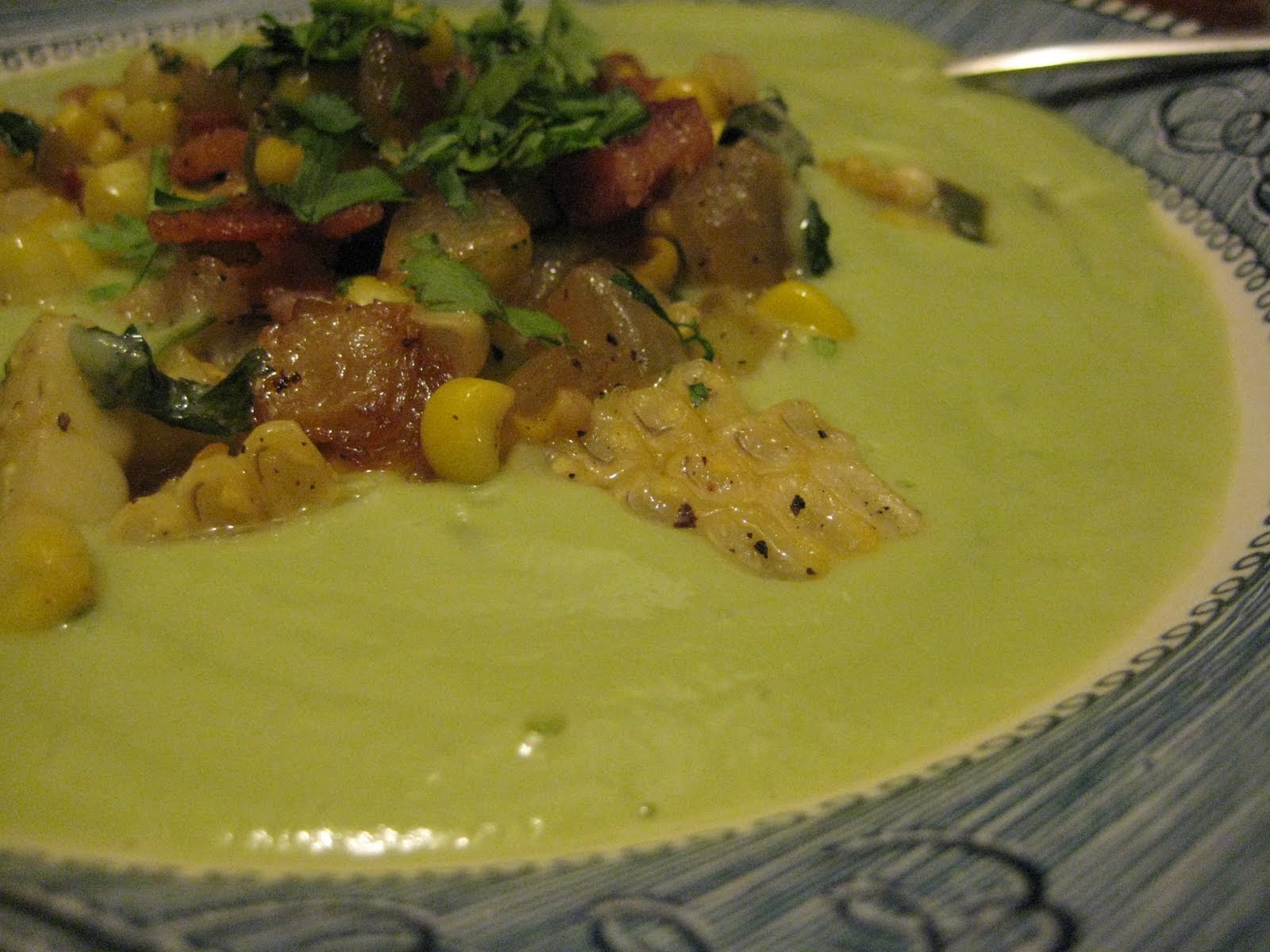
CHILLED AVOCADO SOUP WITH CORN AND BACON


In general, ice cream and popsicles aside, I don’t like cold food. Even in the hottest weather, I prefer my salads at room temperature. And the less said about cold pizza, the better. (Ugh, I can’t get over the congealed melted cheese.) Obviously, then, I have never really warmed (ha) to chilled soups. Most of the gazpachos I’ve encountered have just made me feel like I’m eating a big bowl of salsa. Given that logic, when I spotted this cold avocado soup at Joy the Baker I should have assumed it would taste like eating a big bowl of pureed guacamole, but instead I thought, “Ooh, pretty!” and “Ah, corn and bacon!” Maybe it’s just that I really like guacamole, or maybe the warm topping made it seem less like sauce disguised as a meal to me, but I bookmarked it instantly and made it soon afterward, in the throes of a 100-plus-degree heat wave.

This soup is good, with a wonderful velvety texture. The dominant flavors are, of course, avocado and lime (which I was even more generous with), but the savory broth (the recipe called for vegetable, but I used homemade chicken stock because I like its flavor so much) and the dollop of dairy (the recipe suggested sour cream, crème fraiche, or milk, but I knew plain yogurt—specifically, Trader Joe’s nonfat European-style yogurt, which is thin but not watery and my go-to for stirring into soups and sauces—would be the perfect choice for me) save it from guacamole-dom. I took a taste after blending it up and liked it pretty well but wasn’t sure I could eat a whole bowl of it. But the topping—oh, the topping!

The original recipe called for “cooked bacon,” as though you would just happen to have some sitting around, and then had you sauté the vegetables in olive oil. LOGIC FAIL! The best part of bacon is the grease, specifically the heavenly, transformative things it does to whatever you happen to cook in it. So I fried up some bacon, removed it from the skillet, and then cooked the onion, corn, and jalapeno in it, which was absolutely the correct choice. My second gripe with the original recipe was that it called for parsley when, to me, cilantro is made for moments like this—big handfuls of it, too. I mean, with avocado, jalapeno, and corn, we’re clearly already rocking this soup southwestern-style, am I right? When the topping mixture was all softened and browned and generously seasoned, I took a taste and had to stop myself from eating the entire skilletful with a spoon while standing over the stove. Stirred into the soup, it elevated it from “Hmm” to “Hell yes!”, its smoky heat providing much-needed textural, temperature, and flavor contrasts to the cold green creaminess. Instead of feeling like I was eating a beverage or condiment in a bowl, I thoroughly enjoyed this as a refreshing, satisfying summer meal.

Sauteeing the topping in bacon fat and swapping in cilantro really made this dish extra awesome, but then I made a major misstep in packaging up the leftovers: Not realizing how much I was going to enjoy the interplay between the warm topping and the cold soup, I premixed all my topping and soup portions before putting them in the fridge (perhaps I was a bit distracted by the complicated serving instructions in the original recipe, which asked me to put the topping in the bowls and then add the soup around it; for me, that just ended up burying the topping). When I went to eat the leftovers, I realized this meant I either had to heat the whole thing up (Cooked avocado soup? No thanks) or eat it all cold. It turned out I didn’t enjoy the topping nearly as well cold—especially the soggy-chewy-greasy texture of the bacon—and it was clear I should have stored the two components separately, so I could microwave the topping and then add it to the chilled soup. If I’d done that, this recipe would have been downright perfect. Oh, well; live and learn. I’m almost hoping for another heat wave this month (not unlikely, given Southern California’s traditionally hot Septembers) so I have an excuse to eat this one more time before autumn sets in.

2 ripe avocados
1 cup vegetable or chicken broth
1–2 tablespoons lime juice
2 tablespoons plain yogurt (or sour cream, creme fraiche, or milk)
¾ teaspoon salt, plus extra to taste
1¼ to 1½ cups water
1 tablespoon olive oil
1 small yellow onion, diced
2 ears fresh corn, sliced from the cob
1 small jalapeno pepper, de-seeded and diced
4 slices diced bacon
1 handful cilantro, chopped
Freshly cracked pepper to taste

1. To make the soup, place avocado flesh in a blender along with broth, lime juice, yogurt (or sour cream, crème fraiche, or milk), and ¾ teaspoon salt. Blend until the avocados are creamy. Remove the center from your blender lid, and while blending, slowly add 1¼ cups water. Soup will be done when smooth, with your desired consistency—feel free to add another ½ cup water if you prefer a thinner soup. Taste and add salt and pepper as necessary. Place in a covered container in the fridge (I just left it in the blender pitcher) while you make the topping.

2. To make the topping, cook bacon in a skillet over medium heat until crisp. Remove bacon with a slotted spoon and set on a paper-towel-lined plate to drain. Add onion to the bacon fat in the skillet and cook until translucent and browned, about 5 minutes. Add corn and jalapeno and cook for 3 minutes more. Add bacon and cilantro. Cook until everything is warmed and just browned. Season with salt and pepper to taste.

3. Divide the cold soup into four bowls and top each with one-quarter of the warm topping mixture (unless you’re planning on keeping some of the soup as leftovers—see my note below). Garnish with additional cilantro, if desired.

Serves: 4
Time: 40 minutes
Leftover potential: Soup will last for about three days in an airtight container in the fridge. I recommend storing the topping mixture in a separate container, so you can reheat it before adding it to the cold soup.

Thursday, March 03, 2011

CHICKEN TORTILLA SOUP


It appears I’m on a soup kick this year; this is my fourth new soup recipe in two months. Not only did this recipe at The Pioneer Woman Cooks look colorful and delicious and generally souptastic, but it also gave me an excuse to buy fresh, handmade corn tortillas. Yes, folks, nearly seven years after moving to Los Angeles, I’ve finally found a source for good tortillas. Really, I’m embarrassed that it took me so long to discover the awesome Mexican grocery just a few miles up the road, where you can buy a stack of several dozen perfectly tender, addictively flavorful, ridiculously simple (“ingredients: corn, water”) tortillas for just 99 cents. I’m even more embarrassed that it took me nearly as long to like corn tortillas, because I’d mostly only had the dry, mealy storebought ones. Falling in love with the good ones has been a total revelation.

This is a fairly basic tomatoey chicken and bean soup made remarkable by three things:
  1. Stirring in cornmeal, which I’d never done before, gives a faint nutty, savory flavor and subtly creamy texture.
  2. Those tortillas are the superstars here, added the soup without baking or frying—a rarity among tortilla soup recipes I found online, and dubiously received by some of the commenters, but to me, it makes a lot of sense. It seems more authentic somehow—I can see this recipe originally being created, like chilaquiles, as a thrifty way to use up slightly stale tortillas. It’s such a win-win for common sense: The cheap tortillas bulk up the soup and make the expensive meat stretch further, and the soup rehydrates potentially dried-out old tortillas and makes them toothsome again. But even if you’re using fresh tortillas as I was, it’s still a great idea: The tortillas lend their corny flavor to the soup, the soup’s flavor soaks into the tortillas, and, particularly after a day or more has elapsed, they have the irresistible soft-chewy texture of noodles. Even if you’re skittish about the idea of soggy tortillas, promise me you’ll give it a try. You can always garnish with corn chips if you want the crunchy topping too.
  3. The garnishes really amp things up. As with chili, the sky’s the limit and the combinations are nearly endless. I think avocado, cilantro, and lime are a must, and onions (I used green instead of PW’s red) and cheese are strongly recommended, but you could add salsa/pico de gallo and sour cream as well. I only added avocado to about half the leftover servings, because I had a lot of them and I wasn’t sure how avocado would hold up over the long term (especially if I ended up freezing it). Then later in the week, after making fish tacos (I had a lot of tortillas to use up, after all), made the miraculous discovery that the leftover avocado cream sauce (that’s pureed avocado, lime, cilantro, and yogurt) was excellent when drizzled atop the avocado-less soup portions. When stirred in thoroughly, it froze just fine. In fact, it was so good that next time I’d consider making avocado cream specifically for the purpose of adding it to my tortilla soup.
In short, we really liked this soup. However, I’d do a few things differently next time. Overall, the soup base was blander than I’d expected. Granted, I wasn’t able to cook it quite as long as the recipe directed, and the flavor did improve the next day. But I think there are a few other factors. Using half broth and half water definitely made it taste watered-down; next time, I’ll make a half-recipe (this made a ton) and use all broth. And even gussied up with the spice rub, I don’t think the boneless, skinless chicken breasts did the soup any favors. I don’t really like white meat that much, but even chicken breast off the bone has exponentially more flavor. Usually, I use leftover roasted chicken or chicken I’ve boiled for stock to stir into soups, and I should have followed that impulse here, but I wanted to obey the recipe the first time through. Next time, I’ll do off-the-bone chicken instead (if you don’t usually have a stash of it in your freezer as I do, a storebought rotisserie chicken would do the trick) and just stir all the spice rub into the soup in Step 3. I also think one could squeeze in more veggies: a bit more bell pepper, maybe some fresh or frozen corn kernels, and possibly a diced jalapeno to add a bit more spice? I’ll try all these changes out next time and report back to you. But even if you make the recipe as written in the meantime, I think you’ll be pleased.

2 whole boneless, skinless chicken breasts
2 tablespoons olive oil, divided
1½ teaspoons cumin
1 teaspoon chili powder
½ teaspoon garlic powder
½ teaspoon salt, plus additional salt to taste
1 cup diced onion
½ cup (or more) diced bell pepper
3 cloves garlic, minced
1 14-ounce can diced tomatoes with green chilies (such as Rotel, or Trader Joe’s fire-roasted tomatoes with green chilies; just use a can of diced tomatoes plus a can of green chilies if you can’t find this)
4 cups low-sodium chicken broth
3 tablespoons tomato paste
4 cups water
2 15-ounce cans black beans, drained
3 tablespoons cornmeal
5 corn tortillas, cut into uniform strips
1–2 ripe avocados, diced
Juice of 1 lime
Sliced green onions to taste
Chopped fresh cilantro to taste
Grated pepper Jack, Monterey Jack, or cheddar cheese to taste

1. Preheat oven to 375 degrees. Mix cumin, chili pepper, garlic powder, and salt in a small bowl. Drizzle 1 tablespoon olive oil on chicken breasts, then sprinkle a small amount of spice mix on both sides. Set aside the rest of the spice mix.

2. Place chicken breasts on a baking sheet. Bake for 20 to 25 minutes, or until chicken is just done. Use two forks to shred chicken. Set aside.

3. Heat 1 tablespoon olive oil in a pot over medium high heat. Add diced onion, bell pepper, and minced garlic. Stir and begin cooking, then add the rest of the spice mix. Stir to combine, then add shredded chicken and stir.

4. Pour in diced tomatoes and chilies, chicken stock, tomato paste, water, and black beans. Bring to a boil, then reduce heat to a simmer. Simmer for 45 minutes, uncovered.

5. Mix cornmeal with a small amount of water (I used a couple of tablespoons). Pour into the soup, then simmer for an additional 30 minutes. Check seasonings, adding more if needed—add more chili powder if it needs more spice (I added some chipotle chili powder at this point, which was an excellent decision), and be sure not to undersalt. Turn off heat and allow to sit for 15 to 20 minutes before serving. Five minutes before serving, gently stir in tortilla strips.

6. Ladle soup into bowls, then top with desired garnishes such as diced avocado, lime juice (to keep the avocado fresher, I recommend tossing it with the lime juice and then adding the mixture to the soup), green onions, cilantro, and grated cheese.

Serves: 8
Time: 2½ hours
Leftover potential: Great; leftovers will keep for at least a week in the fridge, improving with time, and can be frozen indefinitely.